For years, the next generation of wireless connectivity has lived mostly in white papers, test labs and conference keynotes. This month, one of the UAE’s two national telecom operators says it has carried a key piece of that future into ordinary homes and offices. du has announced what it describes as the world’s first commercial end-to-end U6GHz connectivity service, a launch that moves the Upper 6GHz band out of the trial phase and into the hands of paying customers.
Announced on 13 October 2026, the service runs on du’s live 5G+ network, also known as 5G-Advanced, and uses commercially available customer premises equipment (CPE), the category of device that includes the internet routers people already use to get online at home and at work. In plain terms, du is saying that the whole chain, from the radio network to the box on the customer’s shelf, is now working together as a real product rather than a demonstration.
What du has actually launched
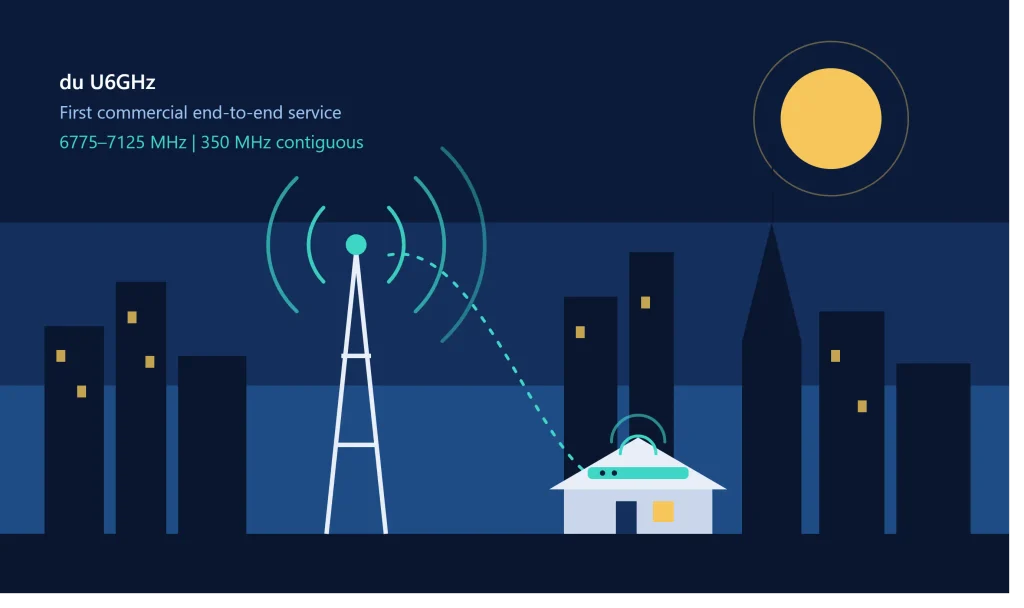
According to the company, the service operates across 350 MHz of contiguous spectrum in the 6775 to 7125 MHz range. That detail matters more than it might first appear. Spectrum is the invisible raw material of every wireless service, and the amount of it an operator can use in a single, unbroken block largely determines how much data the network can move at once. A wide, contiguous slice is far easier to put to work than several scattered fragments.
du has framed the launch as the moment the technology became a practical, customer-ready service. The operator says it is connecting with equipment of the kind customers already use, rather than specialised lab hardware, which is the clearest sign that the service has crossed from experiment to product.
The company also positions the launch as a foundation rather than a finish line. It describes U6GHz as a source of expanded capacity that can support enhanced mobile broadband, next-generation Fixed Wireless Access (FWA), cloud-based AI applications, immersive digital experiences and increasingly connected environments. Each of those is a demand area where today’s networks are being asked to do more every year.
Why “end-to-end” is the phrase that matters
Telecom announcements are full of “firsts”, and the qualifiers attached to them are usually where the real story sits. In du’s case the qualifier is “end-to-end”.
A new spectrum band can be switched on in a laboratory, or on a single test site, or with prototype devices, and still be a long way from something a household can buy. For a commercial service to exist, many pieces must line up at once: radio equipment on the network side, a core network that can manage the connection, transport links with enough capacity behind the antennas, and, crucially, devices on the customer side that can actually talk to all of it. The last link in that chain is often the slowest to arrive, because device makers need mature chipsets and a clear regulatory picture before they commit.
By highlighting its use of commercially available CPE on a live network, du is signalling that the device ecosystem is no longer the missing piece, at least for this category of service. The operator describes the result as a complete network-to-customer solution, and that framing is deliberate. It tells enterprises, developers and device makers that the band is not merely a promise on a roadmap.
Understanding the spectrum
To appreciate why the industry is excited, it helps to understand why this slice of airwaves is so prized. Radio frequencies involve a trade-off. Lower frequencies travel far and penetrate buildings well, but they are crowded and offer limited capacity. Very high frequencies, such as the millimetre waves used in some 5G deployments, can carry enormous amounts of data but only over short distances and with difficulty passing through walls.
The Upper 6GHz range, which industry commentators often call the “golden spectrum”, sits in a sweet spot between the two. Reports describe the wider U6GHz band, spanning 6425 to 7125 MHz, as combining broad coverage with high-capacity performance. For an operator, that means the ability to serve more users, and more data-hungry applications, from the existing grid of towers without needing to build a vastly denser network.
It is also widely seen as an anchor band for what comes next. Industry bodies have described U6GHz as playing a central role in reaching 10 Gbps connectivity and as an initial spectrum for future 6G networks. That is why a commercial launch in this range carries significance beyond any single operator’s marketing.
What it could mean for homes
The most immediate consumer application highlighted in du’s announcement is Fixed Wireless Access. FWA delivers home or office broadband over the mobile network instead of through a cable or fibre line, using a router that connects wirelessly to nearby radio sites. It has become one of the most popular uses of 5G worldwide, particularly where laying new fixed lines is slow or expensive.
The promise of U6GHz-based FWA is that it can offer more capacity per site, which in turn can mean faster and more consistent speeds for households that stream in high resolution, game online, work from home on video calls and run a growing number of connected gadgets at the same time. The average household now carries far more simultaneous devices than it did even a few years ago, and the demand curve points only upwards.
It is worth being measured here. In its announcement, du did not publish consumer pricing, packages, coverage maps or guaranteed speeds, so it remains to be seen how quickly and in which neighborhoods the service will reach people. What the launch establishes is that the technical ingredients are in place and being sold.
What it could mean for businesses
For companies, the picture is arguably more compelling. Many businesses, from retail outlets and pop-up sites to construction projects and temporary event spaces, need fast connectivity quickly and cannot always wait for a fixed line to be installed. A high-capacity wireless service delivered through a plug-in router is an attractive alternative, and a more capable band makes it a more credible one.
The larger prize lies in the workloads du points to. Cloud-based AI applications, for instance, depend on moving large volumes of data between a user’s location and remote computing infrastructure. As businesses adopt AI tools for analytics, customer service, design and operations, the connection becomes a bottleneck unless it keeps pace. Immersive experiences, such as extended reality used for training, retail or entertainment, are similarly bandwidth-hungry and sensitive to delay.
Then there is the broader notion of connected environments, from smart buildings to industrial sites where sensors, cameras and machines share the same network. Extra capacity gives planners more room to add devices without degrading performance for everything else.
The regulator’s role
No operator can launch a service like this without access to spectrum, and du was quick to credit the Telecommunications and Digital Government Regulatory Authority (TDRA). In the company’s words, the regulator enabled the progress through a forward-looking spectrum strategy and continued support for next-generation technologies.
That acknowledgement reflects a wider national effort. Earlier this year, at the SAMENA Leaders’ Summit, the UAE announced the launch of what it called the world’s first commercial U6GHz network and ecosystem, with the TDRA naming Huawei, Nokia, e& and du among its partners. Officials described a goal of becoming a “10-giga intelligent nation”, and the authority called on chipmakers and device manufacturers to take part in commercialising the band. The GSMA’s head of the Middle East and North Africa, Jawad Abbassi, said the region could gain a first-mover advantage by using U6GHz during the 5G-Advanced phase.
In that light, du’s launch can be read as a delivery milestone in a coordinated national strategy, not an isolated product announcement.
A busy race with more than one “first”
Readers following the story will notice that du is not the only UAE operator staking a claim. On 29 September, e& UAE announced the commercial launch of what it called the world’s first mobile network operating on U6GHz using 256TRX Giga-MIMO technology, saying the network could push single-cell throughput beyond 50 Gbps with commercial TDD bands.
The two claims are not necessarily in conflict, because they describe different things. e&’s announcement centred on a mobile network built on large-scale antenna technology. du’s centres on an integrated, customer-facing service delivered through commercially available CPE. Both underline the same point: the UAE has become the early testing ground for how Upper 6GHz performs under real commercial conditions, and its two national operators are competing to demonstrate it.
Such rivalry tends to benefit customers. When operators race to prove a technology, they invest faster, partners deliver sooner and the lessons learned spread through the wider industry.
Building the foundations behind the antennas
Announcing a radio service is one thing; carrying its traffic is another. Separately from this launch, du has been working with Huawei on the transport side of the equation. The company has announced the integration of 50 Gbps E-band Full Duplex microwave backhaul into its U6GHz trial, which it described as a world-first application.
Backhaul is the link that connects a cell site back to the core of the network, and it must scale in step with the radio layer. If antennas can deliver more capacity than the backhaul can carry, the extra spectrum goes to waste. du said it plans to use U6GHz to deliver peak rates of 10 Gbps and is strengthening its transport network to support the UAE’s “10 Giga Vision” and an upcoming wider rollout.
This is the unglamorous but essential engineering behind headlines, and it is a useful reminder that a commercial launch is the visible tip of a much larger infrastructure effort.
From 5G-Advanced to 6G
The language of the announcement repeatedly points beyond the present. du describes the service as laying the groundwork for the evolution from 5G-Advanced toward future 6G networks, and says the milestone supports the UAE’s ambition to be a global leader in 6G.
That framing reflects how the industry now thinks about generational change. 6G is not expected to arrive overnight on a single date. Instead, capabilities and spectrum are being introduced step by step during the 5G-Advanced era, so that when 6G standards mature, much of the physical network, the spectrum and even the devices are already in place. Putting U6GHz into commercial use now gives operators real-world data about coverage, interference, device behaviour and customer demand, all of which will shape later designs.
For the UAE, a country that has made digital infrastructure a pillar of its economic strategy, being early has strategic as well as commercial value. It strengthens the case for the nation as a regional hub for data, AI and advanced technology investment.
What to watch next
Several questions will determine how far this launch travels. The first is availability: how quickly will du extend the service across its footprint, and will it prioritise homes, businesses or both? The second is devices: how broad will the range of compatible routers and, eventually, handsets become, and how affordable will they be? The third is performance: how will the real-world speeds and reliability customers experience compare with the headline potential of the band?
There is also the matter of the wider ecosystem. The TDRA has asked chipmakers and device manufacturers to join the effort, and the speed at which they respond will influence how soon U6GHz moves from a premium service to a mainstream one. Other markets will watch the UAE’s results closely, because regulators elsewhere are deciding how to allocate similar spectrum.
Finally, there is the competitive dynamic between the two UAE operators, which is likely to produce further announcements as each seeks to show leadership in the 5G-Advanced era.
The bigger picture
It is easy to dismiss telecom “world-firsts” as marketing noise, and a measure of scepticism is healthy until pricing, coverage and independent performance data emerge. Yet the underlying shift here is real. A frequency band that the industry has been preparing for years is now being used to serve customers on a live network, through ordinary equipment, in one of the world’s most digitally ambitious countries.
Saleem Alblooshi, du’s Chief Technology Officer, summed up the intent by saying the company is bringing U6GHz into customers’ hands through a fully integrated commercial service. If the rollout delivers on that ambition, the people who notice will not be those reading about spectrum bands. They will be the households whose connections feel faster, the businesses that can open a site in days, and the developers who finally have the capacity to build the immersive, AI-powered services the next decade is expected to demand.
That is the real test of any new generation of connectivity: not whether it is first, but whether it quietly makes everyday digital life work better. On that measure, the story of U6GHz in the UAE is only just beginning.
du adds life to life with a comprehensive portfolio of mobile, fixed, broadband, entertainment services, and fintech solutions. Through a digital-first approach powered by ultra-reliable fiber and 5G technology, du delivers bespoke solutions leveraging cloud computing, AI-driven analytics, advanced cybersecurity, and IoT integration. As a trusted digital telco enabler spearheading the UAE’s digital transformation, du collaborates with a dynamic partner ecosystem to propel industries and society toward operational excellence, shaping a more connected and digitally advanced future across the region.
e& (formerly Etisalat Group) is a global technology and investment group headquartered in Abu Dhabi. e& UAE is its domestic telecom operator, providing mobile, fixed, broadband, digital and enterprise services across the United Arab Emirates.
Huawei is a global provider of information and communications technology (ICT) infrastructure and smart devices, founded in 1987 and headquartered in Shenzhen, China. It supplies network equipment and solutions to telecom operators and enterprises in many countries.
Nokia is a Finnish multinational technology company, headquartered in Espoo, that provides network infrastructure, including mobile, fixed and optical networks, and related software and services to communications service providers, enterprises and governments worldwide.
The TDRA is the United Arab Emirates federal authority responsible for regulating the telecommunications and information technology sectors, managing national spectrum resources and supporting the country’s digital government agenda.
Cosmopolitan The Daily is an online publication delivering news, business, technology, lifestyle and culture stories for a global, city-minded audience. Its editorial desk focuses on clear, timely reporting and on explaining how developments in markets, technology and society affect everyday life.