For decades, the repurchase agreement, or repo, has been the quiet engine room of global finance. Banks, asset managers, hedge funds and dealers swap Treasury securities for cash overnight, then reverse the trade the next day. It is how institutions fund themselves, how markets stay liquid and how the central bank’s policy rates reach the real economy. It is also a market that, for all its importance, still runs largely on schedules and plumbing built for another era.
That is beginning to change. The Canton Network, the privacy-focused blockchain built by Digital Asset, has launched tokenized US Treasuries for use in repo transactions. The tokens serve as collateral for financing deals and can move on a network designed for regulated institutions. Backed by an infrastructure that has been tested through a series of live trades since 2025, the launch moves tokenization from pilot projects toward everyday market use.
What has actually launched
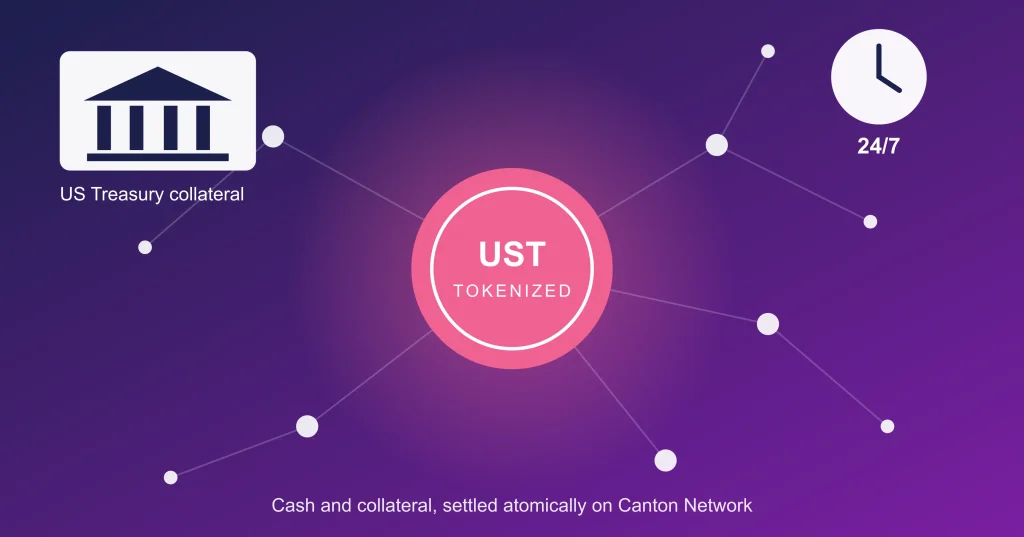
In plain terms, participants can now take US Treasury securities, represent them as digital tokens on Canton, and pledge them as collateral in repo trades against cash. Depending on the transaction, that cash can take several forms: stablecoins, tokenized commercial bank deposits or other digital money. The key feature is atomic settlement. The collateral and the cash change hands at the same instant, or the trade does not happen at all. That removes the gap in which one side has delivered and the other has not.
The infrastructure also works around the clock. Conventional Treasury settlement follows banking hours and weekday calendars. A trade struck on Friday afternoon generally waits until Monday. A tokenized trade is not bound by those limits, so a treasurer who receives funds late in the day, or who needs financing for a few hours over a weekend, has options that did not exist before.
“With tokenization and repo done on the Canton Network, you can do a repo for four hours. You can do a repo over the weekend,” one market participant has said of the shift, describing the flexibility that short-dated, on-demand financing brings to corporate and institutional cash management.
Why repo is the right place to start
Tokenization has been promised for years, and much of the early attention went to novelty assets. Repo is a more pragmatic starting point. It is enormous, it is collateral-driven, and it suffers from precisely the frictions that blockchain-style systems are good at reducing: delays in moving collateral, fragmented record-keeping, limited operating hours and the cost of reconciling many parties’ books.
Collateral is also scarce in the sense that matters most. Firms often hold plenty of high-quality assets but cannot always put them where they are needed at the moment they are needed. Trapped collateral is expensive. If a Treasury held in one place can be mobilized in minutes rather than hours or days, balance sheets can be used more efficiently, intraday liquidity needs can fall, and stress at the end of a trading day can be easier to manage.
US Treasuries are the natural asset for the job. They are the deepest, most liquid and most widely accepted collateral in the world. If tokenization is to earn the trust of conventional institutions, it makes sense to prove itself with the asset those institutions already trust most.
A road built trade by trade
The launch did not arrive out of nowhere. In August 2025, Digital Asset and a group of leading financial firms completed what was described as the first real-time, fully on-chain financing of US Treasuries against the USDC stablecoin on Canton. The repo was executed on Tradeweb and settled atomically on a Saturday, something traditional settlement systems cannot do. The working group included Bank of America, Circle, Citadel Securities, Cumberland DRW, Digital Asset, DTCC, Hidden Road, Société Générale, Tradeweb and Virtu Financial.
Kelly Mathieson, chief business development officer at Digital Asset, called that first live transaction a foundational step toward a “Global Collateral Network” on Canton, stressing the network’s ability to respect institutions’ confidentiality while still operating on a public blockchain.
Follow-on activity widened the scope. After earlier rounds in July and October 2025, a third set of transactions, reported in early 2026, expanded on-chain intraday repo to multiple currencies, collateral types and cross-border flows. Those trades used tokenized commercial bank deposits supplied through LSEG Digital Settlement House as the cash leg, and tokenized collateral including European government bonds and US Treasuries, settling in both euro and US dollars. Using bank deposits rather than stablecoins gave participants a “real cash” option, which matters to institutions that prefer to settle in regulated bank money.
Other tests followed, including cross-border repo using tokenized UK gilts. Taken together, the sequence amounted to a methodical series of rehearsals: first one asset and one type of cash, then more assets, more currencies and more jurisdictions.
The DTCC piece of the puzzle
Perhaps the most consequential development is the involvement of the Depository Trust & Clearing Corporation. DTCC sits at the center of the US securities market, and its subsidiary, the Depository Trust Company, holds the vast majority of securities that Americans and global investors own. When it announced a partnership with Digital Asset and the Canton Network, the message to the industry was significant: tokenization would be built on top of the existing system of record, not around it.
Under that partnership, DTCC planned to enable a subset of US Treasury securities held at DTC to be minted on Canton, using its ComposerX suite of platforms. “DTCC’s partnership with Digital Asset and the Canton Network is a strategic step forward,” said DTCC chief executive Frank La Salla, framing the work as building digital infrastructure that bridges traditional and digital financial ecosystems while delivering scalability and safety.
The approach matters for a simple reason. A token is only as good as the asset behind it. By linking tokens directly to securities held in a regulated custodian, the structure gives market participants confidence that a tokenized Treasury is the real thing, not a lookalike with its own set of risks. DTCC’s Tokenization Service has been set for an October 2026 launch, with the initial phase focused on Treasuries held by DTCC members and a broader rollout of additional DTC- and Fed-eligible assets expected in the second half of 2026. Early participants have already described moving tokenized Treasuries as collateral in production-like environments, including trades of about $10 million and an intraday securities lending transaction in which a participant acted as lender.
Privacy is the quiet differentiator
Much of the skepticism about putting capital markets on public blockchains has centered on privacy. A bank does not want rivals reading its funding positions, and a hedge fund does not want its strategy visible to the world. Canton was designed around that problem. Its architecture uses sub-transaction privacy, meaning that only the parties to a particular transaction, and those with a legitimate need, can see its details, while the network still delivers a shared, synchronized view of what has been settled.
That design lets participants interact across institutions and even across independently operated systems without revealing portfolios, counterparties or trading intentions to everyone else. For regulated firms, it is often the difference between an interesting experiment and something their compliance teams can approve.
It also helps explain why Canton has attracted existing market infrastructure. Broadridge’s Distributed Ledger Repo platform runs on Canton and has been reported to process more than $8 trillion in repo transactions a month, which shows that the network is already handling volumes of a scale few blockchain projects can claim.
What it means for market participants
For banks and dealers, the near-term benefit is operational. Faster, atomic settlement reduces counterparty exposure and the capital held against it. Automated lifecycle management, including collateral substitution, margin calls and unwinds, cuts down on manual processing and on the errors that come with it.
For asset managers and corporate treasurers, the promise is flexibility. Cash that arrives late in the day need not sit idle until tomorrow. Short, on-demand financing windows can open up. The ability to raise cash against Treasuries on a weekend or holiday could prove valuable in a volatile market, when conditions can shift while traditional rails are closed.
For regulators and policymakers, the picture is more nuanced but broadly encouraging. Atomic settlement and better data on collateral movements could, in principle, improve transparency and reduce some forms of operational risk. At the same time, a market that never closes raises fresh questions about liquidity management, supervision and the behavior of automated strategies outside regular hours.
The challenges that remain
None of this guarantees a smooth path. Liquidity is the first test. A tokenized market is useful only if enough participants use it, and early volumes, while promising, are small relative to the trillions that flow through conventional repo each day. Network effects take time to build.
Interoperability is the second. Collateral and cash will often sit on different systems, and firms will want to move between them without friction. Canton’s ability to connect with other ledgers and platforms is a design goal, but real-world connections must be tested at scale and under stress.
Legal and regulatory clarity is the third. Questions about how tokenized securities are treated for custody, collateral perfection, bankruptcy and capital rules must be answered consistently across jurisdictions. The involvement of DTCC and established regulated entities helps, but the rulebook is still evolving, and cross-border activity will test it.
Finally, there is the cash leg. Stablecoins, tokenized deposits and central-bank-linked solutions each carry different risk and regulatory profiles. The market has begun to experiment with several of them, and the question of which will become dominant is far from settled.
What comes next
The roadmap points beyond US Treasuries. Participants have indicated interest in extending on-chain repo to other sovereign debt, including UK gilts, European government bonds and Japanese government bonds, alongside deposit tokens issued by banks. Tests involving cross-border and cross-currency repo have already shown the concept travelling beyond a single market, and Japanese financial institutions have been exploring on-chain repo for domestic government bonds as part of broader efforts to digitize wholesale markets.
DTCC’s plans also reach beyond Treasuries to other eligible assets, including equities and exchange-traded funds, which would widen the pool of tokenized collateral available to the network. Each addition makes the system more useful, since collateral that can move is more valuable the more places it can go.
Investor appetite appears to be keeping pace. Digital Asset has attracted backing from a large roster of financial institutions and investors, and the broader market for tokenized real-world assets continues to grow. Whether that enthusiasm converts into lasting volume will depend on execution: reliable operations, clear rules and tangible savings for the firms that adopt the technology.
The bottom line
Tokenization has often been presented as a revolution that would sweep away the old financial system. The Canton launch tells a different and more credible story. It is evolutionary, built on regulated custodians, familiar assets and trusted market infrastructure, with new technology applied where it solves real problems: speed, availability and collateral mobility.
If the model scales, the repo market may be remembered as the place where tokenization stopped being a pilot and became part of how finance actually works. For now, the milestone is clear. Tokenized US Treasuries are no longer just a demonstration; they are collateral, and they are working.
London Stock Exchange Group is a global financial markets infrastructure and data provider. Its LSEG Digital Settlement House supports the use of tokenized commercial bank deposits for on-chain settlement.
Broadridge is a global fintech provider of investor communications, technology and operations services. Its Distributed Ledger Repo platform, built on Canton, supports intraday and term repo for major banks.
Tradeweb Markets operates electronic marketplaces for rates, credit, equities and money markets, connecting institutional, wholesale and retail clients worldwide.
The Depository Trust & Clearing Corporation is the post-trade market infrastructure for the global financial services industry. Through subsidiaries including The Depository Trust Company, it provides clearing, settlement and custody services, and safeguards a very large share of US securities.
The Canton Network is a public, permissionless-access blockchain network designed for regulated finance. Using sub-transaction privacy, it lets institutions transact and synchronize across applications while keeping sensitive data confidential. It supports use cases including repo, collateral management and tokenized real-world assets.
Digital Asset builds institutional-grade blockchain technology for financial markets. It is the principal developer of the Canton Network and the Daml smart contract language, and works with banks, asset managers and market infrastructure providers on privacy-enabled, interoperable digital markets.
Cosmopolitan The Daily is a digital news and lifestyle publication covering world affairs, business, technology, culture and trends for a global, curious audience. It aims to deliver timely, readable reporting and thoughtful analysis every day