Every time a wind farm feeds power into a distant city, or a data center draws electricity from the grid, a quiet chain of heavy equipment makes the transfer possible. At the center of that chain sits the high-voltage transformer. Hitachi Energy has now committed R$385 million, about US$77 million, to making sure the components inside those machines are built closer to the people who need them.
The investment will expand Brazilian manufacturing of bushings and tap changers for high-voltage transformers. Brazil is already the only country in Latin America that produces both components locally. The company says the new money reinforces that position and will let it supply customers across the region with shorter lead times, a more resilient supply chain and better availability of parts that are often hard to source.
What Hitachi Energy is building
The plan has two main parts. The first is a new industrial unit in Pindamonhangaba, in the Paraíba Valley of São Paulo state, dedicated to bushings and tap changers. It will sit alongside the power transformer complex that the company is already building in the same city, so the finished transformers and some of their most sensitive components will be produced within the same industrial footprint.
The second part is an expansion of insulating materials production at the existing Guarulhos site, also in São Paulo state. Insulation is the unglamorous foundation of high-voltage equipment, and a plant that cannot get enough of it cannot ship enough finished product. By scaling that capability alongside the new unit, the company is addressing a bottleneck at the source.
Hitachi Energy expects the project to create more than 120 direct jobs. With this commitment, the company’s cumulative investments in Brazil will pass US$350 million, according to the announcement. The figure covers a broader strategy to deepen its industrial presence in the country, combining manufacturing capacity, technology, components and services.
Two components most people never see
Bushings and tap changers rarely make headlines, yet a transformer cannot do its job without them.
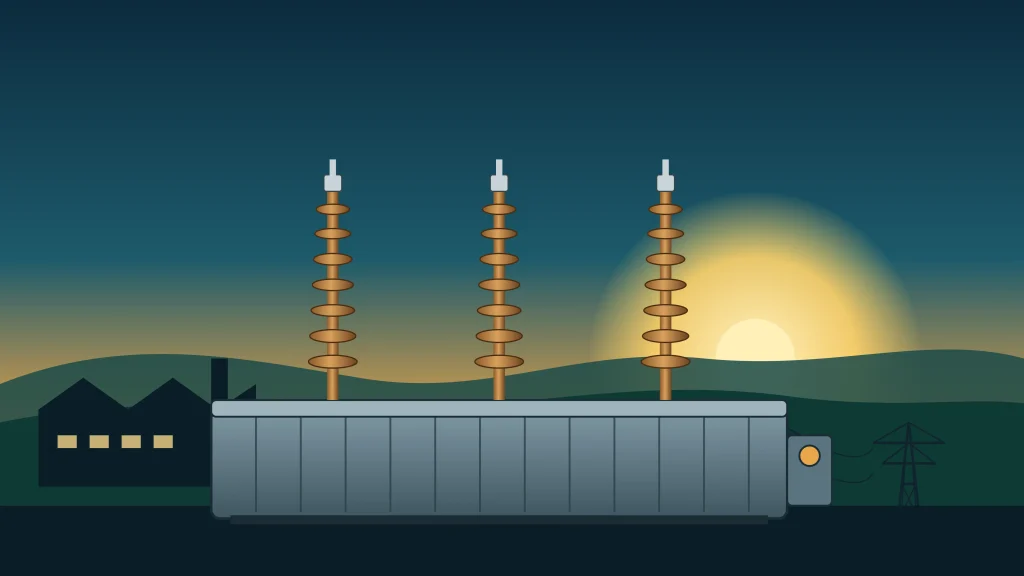
A bushing is the point where electricity passes safely between the outside world and the inside of a transformer. It carries current through a grounded barrier, such as the metal tank, while keeping the high voltage insulated from it. The tall, ribbed columns visible on top of substation transformers are usually bushings. Their specification and performance matter because a failure can compromise the safety and reliability of an entire substation.
A tap changer does a different but equally important job. Grid voltage is never perfectly steady. Demand rises and falls through the day, renewable generation fluctuates with the weather, and long transmission lines lose voltage along the way. A tap changer adjusts the transformer’s winding ratio so that output voltage stays within acceptable limits. In a grid that is adding more variable generation every year, that regulating role is becoming more demanding, not less.
Because both parts are specialized, built to tight tolerances and tested heavily, only a limited number of manufacturers in the world can make them at the voltage levels that modern transmission systems require. That scarcity is part of why local production in Latin America carries real strategic weight.
Shorter supply lines, fewer surprises
Hitachi Energy says the expansion is designed to cut delivery times and reduce reliance on components imported from Europe and Asia. For utilities and developers planning transmission projects, that matters in practical terms. A transformer order can take a long time to fulfill, and a missing bushing or tap changer can hold up an otherwise finished unit.
The past several years have shown how exposed global equipment supply chains can be. Shipping disruptions, geopolitical tensions and surges in demand for grid hardware have all stretched delivery schedules. Producing critical components in the same region where transformers are installed, and in some cases in the same industrial complex where they are assembled, gives customers a buffer against shocks that originate half a world away.
The company also frames the investment as a service story. Rather than simply selling equipment and moving on, it wants to stay close to customers across the life of their assets. Local component production supports that goal, since spare parts, replacement bushings and refurbishment work are far easier to deliver when the factory is a short distance away.
Automation and new technology on the factory floor
The new unit is not simply a bigger copy of what already exists. Hitachi Energy plans to equip it with robotic automation, automated guided vehicles, known as AGVs, and digitalized production processes. Part of the budget will also go toward modernizing existing operations and bringing in newer manufacturing technologies.
The product range will broaden as well. The facility will increase the company’s offer of bushings with oil-impregnated paper insulation, a long-established technology valued for its proven track record in high-voltage service. It will also raise capacity for dry bushings insulated with resin, which avoid the oil inside the bushing and are often favored where fire safety, environmental concerns or maintenance simplicity are priorities. Offering both lets customers choose the technology that suits their application and operating conditions rather than adapting their requirements to what a supplier happens to stock.
Automation and digitalization also improve consistency and traceability. For components that must perform reliably for decades, being able to document how each unit was made is a competitive advantage as well as a quality control measure.
Forty years of know-how
The investment builds on a deep local base rather than starting from scratch. According to Hitachi Energy, its Brazilian operations have produced 100,000 bushings and 4,000 tap changers over the past 40 years, a milestone the company reached in 2026.
Alexandre Malveiro, who leads the company’s Transformers Hub for Latin America, tied the new investment directly to that experience. He said Brazil has well-established industrial expertise in transformer components, and that the new funding is another step in a journey of expanding scale while bringing in more advanced technologies and processes to serve growing demand in Brazil and in global markets.
That last point is worth noting. Although the announcement emphasizes Latin America, the company is clearly thinking beyond the region. Brazilian-made components can serve the local market while also supporting the company’s wider transformer network.
One piece of a much larger program
The R$385 million commitment does not stand alone. It follows a series of announcements that have steadily raised Hitachi Energy’s stake in Brazilian manufacturing.
In September 2024, as the company marked 70 years of operations in Brazil, it announced an investment of more than US$200 million to expand transformer operations in the country. That package covered the expansion of existing capacity in Guarulhos and the construction of a new, advanced transformer factory in Pindamonhangaba, with completion targeted for 2028 and more than 600 jobs expected. It formed part of a US$1.5 billion global plan to ramp up transformer manufacturing.
In March 2026, the company added US$150 million across Latin America. Of that, US$80 million was earmarked for the Dosquebradas transformer factory in Colombia and US$70 million for Brazil, to accelerate growth at Pindamonhangaba and Guarulhos through 2027. The company described Latin America as pivotal to its global strategy for meeting unprecedented demand for power transformers.
The new component investment, in turn, forms part of a worldwide program that the company puts at more than US$9 billion, which it describes as the largest in its industry. That program spans manufacturing capacity, research and development, engineering and partnerships, all aimed at keeping pace with global electrification.
The Pindamonhangaba factory is also meant to export. The company has said that, besides serving projects in Brazil, the plant will supply power transformers to North America, Europe and the Middle East, adding capabilities for advanced technologies and drawing on experience from major high-voltage direct current transmission links. It is being integrated into the company’s TrafoStar platform, which harmonizes transformer design, manufacturing and quality control across its global factories.
Why demand keeps rising
Behind all this spending sits a simple reality: the world needs far more grid equipment than it has been building. Several forces are pushing in the same direction at once.
Renewable energy is the most visible. Brazil’s electricity mix is already among the cleanest of any major economy, and further growth in wind and solar means new connection points, new substations and more transformers to step power up for transmission and back down for use. Transmission corridors across a country the size of Brazil are long, and each stretch needs reliable equipment at either end.
Data centers are a newer and fast-growing driver. Large digital facilities need dependable, high-capacity power, and operators building in Latin America are looking for grid connections that can support them. Hitachi Energy has pointed to data centers, large industrial applications and renewable expansion as key reasons transformers have become so central to infrastructure planning.
Finally, existing assets are aging. Many transformers installed decades ago are approaching the point where they need refurbishment or replacement, which sustains demand for components even where no new capacity is being added.
Leadership perspective
Glauco Freitas, who heads South Latin America and serves as country managing director for Hitachi Energy in Brazil, described the investment as part of a broader effort to strengthen the company’s local operation. He said the aim goes beyond raising production capacity: it is to build an operation that brings the company closer to customers and supports them throughout the full life cycle of their assets, while expanding Brazil’s strategic role in the company’s global activities.
That framing, combining industrial capacity, technology, components and services, reflects a shift in how large equipment makers see themselves. Selling a transformer is only the start of the relationship. Keeping it running for forty years or more is where much of the value, and much of the customer trust, is built.
What to watch next
Several questions will determine how much impact the investment has in practice.
The first is timing. The announcement describes the plan and its scope, but customers will want to know when the new capacity comes online and how quickly lead times actually fall. The Pindamonhangaba transformer complex is itself still under construction, so the schedules of the two projects will be closely linked.
The second is talent. Operating robotic, digitalized production lines requires technicians, engineers and maintenance specialists with skills that are in short supply. The 120 direct jobs the company has promised are only part of the picture, and the broader ecosystem of suppliers, training institutions and logistics providers around São Paulo state will also shape results.
The third is regional competition and policy. Other countries in Latin America are courting manufacturers and investors, and industrial policy, local content rules and energy auctions can all affect where equipment makers choose to expand. Brazil’s position as the region’s only local producer of these two components gives it an advantage, but advantages in manufacturing need to be defended.
Even so, the direction of travel is clear. As electrification accelerates, the parts that rarely get noticed become the parts that determine whether projects finish on time. By putting more of that production in Brazil, Hitachi Energy is betting that proximity, scale and technology will matter as much to customers as price. For a region that is building out its grid at speed, that bet looks well timed.
Hitachi Energy is a global technology leader working to advance a sustainable energy future for all. It serves customers in the utility, industry and infrastructure sectors with solutions and services across the energy value chain, and it pioneers technologies such as high-voltage direct current transmission. Working with customers and partners, it aims to accelerate the energy transition and make the world’s energy system more sustainable, flexible and secure. The company has an extensive installed base in more than 140 countries, is headquartered in Switzerland, and employs around 50,000 people worldwide. In Brazil it operates manufacturing sites in Guarulhos (SP) and Blumenau (SC), with a new transformer factory under construction in Pindamonhangaba (SP).
Hitachi, Ltd. is a Tokyo-headquartered global technology group and the parent of Hitachi Energy. Through its Social Innovation Business, Hitachi combines operational technology, information technology and products to create solutions for energy, mobility, industry and digital infrastructure, with the aim of building a more sustainable society through data and technology.
Cosmopolitan The Daily is a digital publication that brings readers news, analysis and features from across business, technology, culture and lifestyle, with a global outlook and an emphasis on clear, reader-first storytelling. Its editorial team is committed to accuracy, fairness and timely reporting on the stories shaping an interconnected world. For editorial enquiries, advertising or partnerships, please contact the editorial desk.