Cambodia is accelerating its shift away from fossil fuels following a series of landmark financing commitments from the Asian Development Bank (ADB), totalling nearly $145.9 million across two major programs. The investment positions Cambodia as one of Southeast Asia’s most ambitious clean energy reformers, with a national target to source 70% of its electricity from renewable energy by 2030.
A Grid-Defining Battery Storage Project
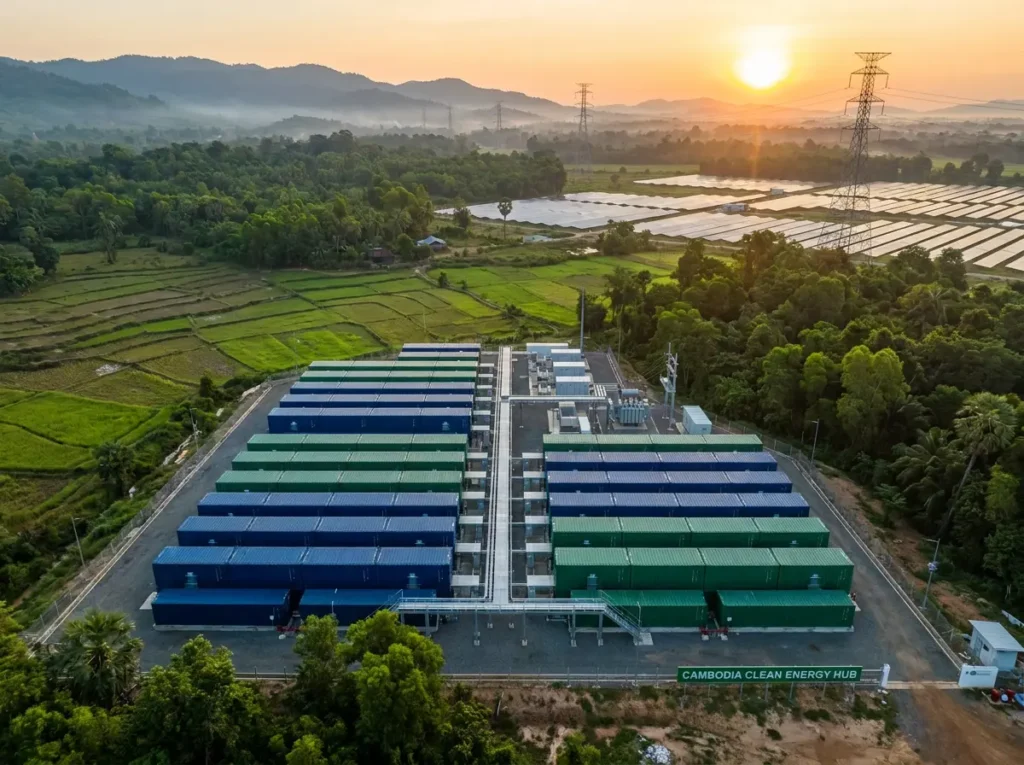
At the heart of the initiative is a $63.44 million financing package approved by ADB for Cambodia’s first utility-scale Battery Energy Storage System (BESS). The facility — a 250-megawatt/500-megawatt-hour installation — will be constructed at the Takeo substation in southern Cambodia.
The project addresses one of the most pressing technical challenges confronting renewable-energy-dependent grids: intermittency. Solar and wind generation is inherently variable, and without adequate storage capacity, excess energy is lost while supply gaps drive reliance on fossil fuels. The Takeo BESS will act as a large-scale buffer, capturing surplus renewable power during periods of peak generation and dispatching it into the grid on demand.
The facility is expected to:
- Reduce greenhouse gas emissions by up to 27,700 tonnes annually
- Enable greater integration of solar and other variable renewable energy sources into Cambodia’s national power system
- Strengthen grid stability and reliability across the country’s expanding electricity network
Cambodia currently relies on coal for approximately half of its grid electricity — a proportion the government is targeting to dramatically reduce within this decade.
The Energy Transition Sector Development Program
The battery project builds on a broader policy and investment architecture established through ADB’s Energy Transition Sector Development Program (ETSDP). The program operates in phases, each designed to deepen institutional reform and expand the scope of private sector participation.
Subprogram 1 introduced foundational policy measures to accelerate clean energy adoption and supported initial investments in energy storage and efficiency initiatives.
Subprogram 2, approved on 6 October 2025 and valued at $82.5 million, advances the country’s reform trajectory further. A flagship feature of this phase is the establishment of an Energy Efficiency Revolving Fund — a dedicated financing mechanism targeting small and medium-sized enterprises (SMEs). The fund will allocate $20 million to enable businesses to adopt cost-saving, low-carbon technologies, with a minimum of 30% of disbursements directed toward women-owned or women-led enterprises.
The program’s projected outcomes by 2029, relative to a 2023 baseline, include:
- A 30% increase in renewable electricity generation
- A 9% reduction in annual electricity demand
- 280,000 tonnes of CO₂ equivalent in annual savings sustained over 15 years
Multilateral Coalition Drives Financing
The scale and ambition of Cambodia’s energy transition has attracted a multilateral coalition of financiers, coordinated through the ASEAN Catalytic Green Finance Facility (ACGF).
For Subprogram 1, ACGF mobilised $22 million in co-financing from the ASEAN Infrastructure Fund (AIF) and the Green Climate Fund (GCF), while also providing technical assistance to support implementation and the preparation of subsequent phases.
For Subprogram 2, ACGF is contributing $30 million in co-financing drawn from AIF, GCF, and the United Kingdom, alongside dedicated technical assistance. The UK’s participation reflects growing international alignment around financing clean energy transitions in emerging markets.
Strategic Implications for Southeast Asia
Cambodia’s energy reform program carries significance well beyond its national borders. As one of the fastest-growing economies in the ASEAN region, Cambodia’s ability to scale renewable capacity without compromising energy security provides a replicable model for neighbouring nations navigating similar transitions.
The deployment of utility-scale battery storage — a technology still nascent across much of the developing world — demonstrates that multilateral development finance can bridge the gap between policy ambition and commercially viable infrastructure.
For regional business leaders and investors, the program signals a structural shift in Cambodia’s energy market: one moving from coal dependence to a more diversified, technology-driven grid. This transition carries direct implications for industries from manufacturing to real estate, where energy reliability and cost stability are increasingly factored into investment decisions.
The Asian Development Bank (ADB) is a regional multilateral development bank headquartered in Manila, Philippines. Established in 1966, ADB is owned by 69 members — 49 from within Asia and the Pacific. Its mission is to promote social and economic development in Asia and the Pacific through loans, technical assistance, grants, and equity investments. ADB is a leading financier of climate and clean energy infrastructure across the region, committing to making 75% of its committed projects climate-related by 2030.
About the ASEAN Catalytic Green Finance Facility (ACGF)
The ASEAN Catalytic Green Finance Facility (ACGF) is an ASEAN Infrastructure Fund initiative administered by the Asian Development Bank. Established to help ASEAN governments develop and finance infrastructure projects that promote environmental sustainability and contribute to climate change goals, ACGF mobilizes finance from a diverse pool of public and private sources. It provides both direct co-financing and technical assistance to support governments in preparing and implementing transformative green infrastructure programs.
The ASEAN Infrastructure Fund (AIF) was established in 2012 by ASEAN member states and the Asian Development Bank to address the region’s significant infrastructure financing gap. AIF supports governments to deliver projects that advance sustainable and inclusive economic growth, with a focus on energy, transport, water, and information and communication technology. AIF operates as a key co-financing vehicle within the ASEAN Catalytic Green Finance Facility.
The Green Climate Fund (GCF) is the world’s largest dedicated fund for climate action in developing countries. Established under the United Nations Framework Convention on Climate Change (UNFCCC), GCF works to limit or reduce greenhouse gas emissions in developing countries and to help vulnerable societies adapt to the unavoidable impacts of climate change. GCF mobilises and channels finance to governments, private entities, and civil society organisations working on transformative climate projects globally. Learn more at www.greenclimate.fund .
The Royal Government of Cambodia has positioned sustainable energy development as a national priority, enshrined in its National Energy Efficiency Policy and its Nationally Determined Contribution under the Paris Agreement. The government’s 2030 target of 70% renewable electricity capacity reflects a strategic commitment to energy security, economic competitiveness, and climate resilience. The Ministry of Mines and Energy oversees Cambodia’s electricity sector, including the state-owned utility Electricité du Cambodge (EDC), which will operate the battery storage facility at Takeo.
Cosmopolitan The Daily is a global business publication delivering comprehensive coverage of Finance, Technology, Energy, Real Estate, and other key sectors across international markets. With offices spanning New York, Toronto, London, Dubai, Bangalore, Kuala Lumpur, and Sydney, Cosmopolitan The Daily provides breaking news and in-depth market insights to directors and executives of leading companies worldwide.
The publication combines authoritative business journalism with its annual Business Excellence Awards program, recognising innovation and value creation across industries and geographies. Cosmopolitan The Daily’s reporting is 100% original, produced by specialist editorial teams embedded in seven major business capitals — offering localised analysis delivered with a genuinely global perspective.