Dubai’s real estate sector, which only months ago was recording the most prolific transaction volumes in its history, is now facing a sharp and accelerating correction — one that analysts say is being driven by a confluence of geopolitical shock, structural overvaluation, and deteriorating investor confidence.
Sales volumes in the emirate have fallen approximately 41% from January through May 2026, according to data from the DLD Analytics tracker, in what market observers are describing as one of the most abrupt reversals the market has seen in recent memory.
A Market That Had Nowhere to Go But Down
The scale of the current slowdown can only be fully understood against the backdrop of the extraordinary boom that preceded it. Dubai’s residential property prices surged roughly 60% between 2022 and early 2025 — a historic rally fueled by the city’s tax-free environment, liberalized visa policies, and a sustained influx of high-net-worth individuals fleeing geopolitical instability elsewhere.
In 2025, Dubai registered over 267,000 real estate transactions worth upwards of AED 624 billion — the highest figures in the sector’s history. Demand appeared inexhaustible, off-plan launches were oversubscribed within hours, and international capital continued to pour into the market from Europe, Asia, and the wider Gulf.
But as early as mid-2025, cracks began to form. Credit rating agency Fitch Ratings had already forecast, prior to any escalation in regional conflict, that Dubai property prices would undergo a correction of approximately 15% between July 2025 and the end of 2026 — the natural consequence of a market that had run too far, too fast.
The Iran Conflict: A Catalyst, Not the Cause
The regional conflict involving Iran, which began in early 2026, has dramatically accelerated the correction that analysts had already flagged as inevitable.
According to analysis by Goldman Sachs, real estate transaction volumes across the UAE fell 37% year-on-year and 49% month-on-month in the first 12 days of March 2026 — the period immediately following the outbreak of hostilities. The figures represent one of the sharpest short-term contractions the Gulf property market has recorded outside of the 2009 financial crisis.
The decline has continued unabated. Proprietary data from property research firm ValuStrat shows sales in Dubai dropped 19% in May compared with April — itself a month that had already registered a 4% sequential decline. The pace of deceleration, analysts note, is gaining momentum rather than stabilising.
“We have analyzed the loan books of all rated UAE banks, and corporate real estate in particular poses the biggest risk among the areas of the economy most sensitive to conflict-related spillovers,” said Anton Lopatin, Senior Director covering UAE banks at Fitch Ratings, speaking from Dubai.
Structural Pressures Compound Geopolitical Risk
Beyond the immediate shock of regional hostilities, Fitch has revised its outlook to reflect a broader deterioration in the economic fundamentals that underpinned Dubai’s property boom.
The agency now expects a larger price correction than its initial 15% forecast, citing a combination of weaker economic activity, reduced tourism arrivals, and slowing population growth — three pillars that had sustained the market’s decade-long bull run.
Commercial real estate is considered particularly exposed. Corporate occupiers are reassessing expansion plans, and trophy office assets — which had commanded premium rents during the boom — are beginning to see tenants renegotiate lease terms or seek exits.
Residential property, while showing greater resilience in the off-plan segment, is not immune. Ready property transactions — those involving completed units available for immediate occupation — have borne the brunt of the volume decline, as buyers and investors adopt a wait-and-see posture amid unresolved geopolitical uncertainty.
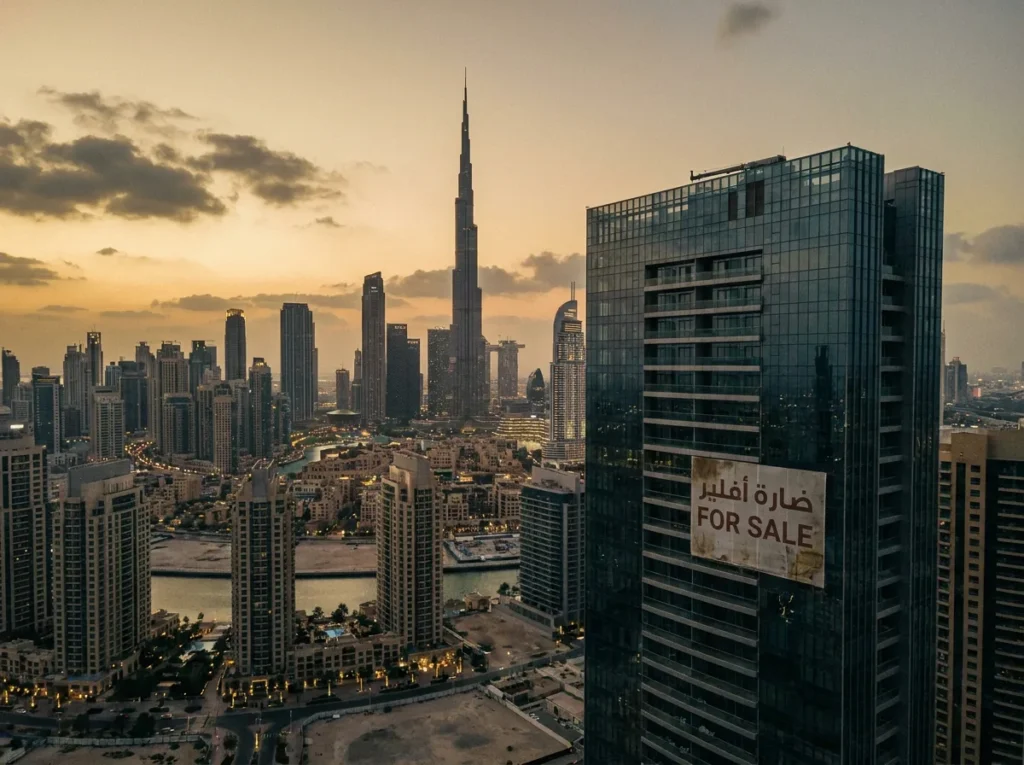
A Record That Now Reads Differently
Perhaps the most telling indicator of the market’s psychological shift is how a major transaction milestone from March 2026 is now being interpreted.
In the opening weeks of the Iran conflict, Dubai recorded the largest residential land transaction in its history — a deal valued at AED 400 million ($100 million). At the time, it was announced to considerable fanfare as evidence of the market’s resilience. In retrospect, analysts view it as an outlier that masked a broader collapse in transaction confidence playing out simultaneously across the rest of the market.
The episode is emblematic of a market that continues to produce headline-grabbing deals at the top end, even as mid-market and retail investor activity contracts sharply — a bifurcation that historically precedes broader corrections.
What Comes Next
The near-term outlook hinges heavily on whether the regional conflict de-escalates, and how quickly international investor confidence returns. In the absence of a ceasefire, analysts caution that the correction could extend well beyond Fitch’s revised projections.
Dubai’s government has not announced any direct intervention measures for the property market, and regulators have maintained that the sector remains fundamentally sound over a longer horizon. However, the speed and depth of the current downturn has led several real estate advisory firms to quietly revise their full-year 2026 forecasts downward.
For the thousands of off-plan investors who committed capital at peak 2024–2025 valuations, the coming quarters will be a test of both financial exposure and patience.
ValuStrat is a leading international strategy and consulting group headquartered in Dubai, with a presence across the UAE, Saudi Arabia, Qatar, and the wider GCC. The firm is recognized for delivering data-driven advisory, valuations, research, transaction advisory, and due diligence services across the real estate, financial, and industrial sectors. ValuStrat’s proprietary VPI (ValuStrat Price Index) is widely cited by market participants, policymakers, and media as a benchmark for residential property price movements in Dubai and Abu Dhabi. The firm serves a client base that includes sovereign wealth funds, institutional investors, banks, and multinational corporations.
Goldman Sachs is one of the world’s foremost global investment banking, securities, and investment management firms. Founded in 1869 and headquartered in New York, the firm serves a diversified client base that includes corporations, financial institutions, governments, and high-net-worth individuals across more than 40 countries. Goldman Sachs maintains a significant presence in the Middle East and Gulf region, where it provides advisory, capital markets, and economic research services. The firm’s macro and sector research — including its analysis of UAE real estate transaction volumes — is closely followed by institutional investors worldwide.
Fitch Ratings is one of the world’s three major global credit rating agencies, alongside Moody’s and S&P Global Ratings. Headquartered in New York and London, Fitch provides credit ratings, commentary, and research across sovereign, corporate, structured finance, and financial institutions sectors globally. The agency maintains an established coverage of UAE banking institutions and Gulf real estate markets, with analysts based locally in Dubai. Fitch’s forecasts and ratings actions are closely monitored by bond investors, bank regulators, and real estate professionals as forward-looking indicators of credit and sector risk.
Cosmopolitan The Daily is a global business publication delivering comprehensive, original news coverage and in-depth market intelligence across the Finance, Technology, Energy, and Real Estate sectors. With editorial teams spanning seven major business capitals — New York, Toronto, London, Dubai, Bangalore, Kuala Lumpur, and Sydney — the publication provides senior executives, company directors, and institutional decision-makers with the international perspective and sectoral expertise required to navigate complex global markets.
In addition to its daily editorial output, Cosmopolitan The Daily operates the annual Business Excellence Awards, a globally recognized program that identifies and formally recognizes innovation and value creation across industries and company sizes — from growth-stage startups to established multinational corporations.
The publication offers a full suite of media and visibility services including print and online advertising, native content, newsletter promotions, and exclusive editorial partnerships tailored to organizations seeking authoritative reach among C-suite and director-level audiences worldwide.