Eritrea is entering a new phase of economic repositioning, as the Horn of Africa nation takes calibrated steps toward decarbonising its energy supply and overhauling a financial sector that has long constrained private investment and economic growth. The convergence of rising macroeconomic stability, targeted international development support, and an expanding global renewable energy framework is opening a window of opportunity for the country to rewire its infrastructure — both physical and financial.
According to the latest economic outlook published by the African Development Bank Group, Eritrea recorded real GDP growth of 3.2% in 2025, up from 2.9% in 2024, driven by expansion in the mining and services sectors alongside household consumption and public expenditure. Looking ahead, GDP growth is projected at 2.8% in 2026, rising again to 3.2% in 2027 — a trajectory that, while modest, reflects a stabilising macroeconomic foundation. Inflation eased from 7.5% to 5.3% over the same period, supported by improved domestic supply and declining imported price pressures.
Yet the path to sustained growth hinges on two interlinked reforms: accelerating the transition to clean, reliable energy, and modernising a financial system that the African Development Bank itself describes as “narrow and state-controlled, limiting financial intermediation, private sector credit, and investment-led growth.”
The Energy Imperative
Eritrea’s energy landscape remains one of the most pressing development challenges in the region. Electricity access rates are among the lowest on the continent, with large swathes of the rural population reliant on biomass and diesel-powered generation — a situation that suppresses productivity, household welfare, and the operational viability of small enterprises.
The country’s geography, however, offers a compelling natural endowment. Eritrea’s Red Sea coastline and elevated interior plateaus provide strong solar irradiation levels and consistent wind corridors — two attributes that have increasingly drawn the attention of international clean energy bodies and development finance institutions. The Global Electrification Platform, a multilateral initiative tracking universal energy access, has modelled electrification investment scenarios for Eritrea extending to 2025 and 2030, providing planners with data-driven frameworks for deploying distributed solar and grid-connected renewable capacity.
The Global Environment Facility (GEF), through its implementing partner the United Nations Environment Programme (UNEP), has committed a $4.93 million grant to support Eritrea in preparing its Biennial Transparency Reports and National Communications to the United Nations Framework Convention on Climate Change (UNFCCC). This investment in climate data infrastructure is a foundational step: robust emissions accounting and energy transition planning require the institutional capacity to measure, report, and verify progress — precisely the groundwork this programme is designed to build.
Development practitioners from Deutsche Gesellschaft für Internationale Zusammenarbeit GmbH (GIZ), Germany’s federal development agency, have maintained an operational presence across the East Africa region, including engagement on sustainable infrastructure and energy access programmes. GIZ’s work in fragile and constrained contexts — combining technical assistance with capacity building — aligns directly with the structural gaps Eritrea must address to scale clean energy deployment.
The International Renewable Energy Agency (IRENA) and the International Energy Agency (IEA) both track Eritrea’s renewable power capacity and generation data as part of their global statistical frameworks, reinforcing an international consensus that even nations with limited current capacity represent viable markets for targeted clean energy investment — particularly as the cost of solar photovoltaic technology continues its structural decline.
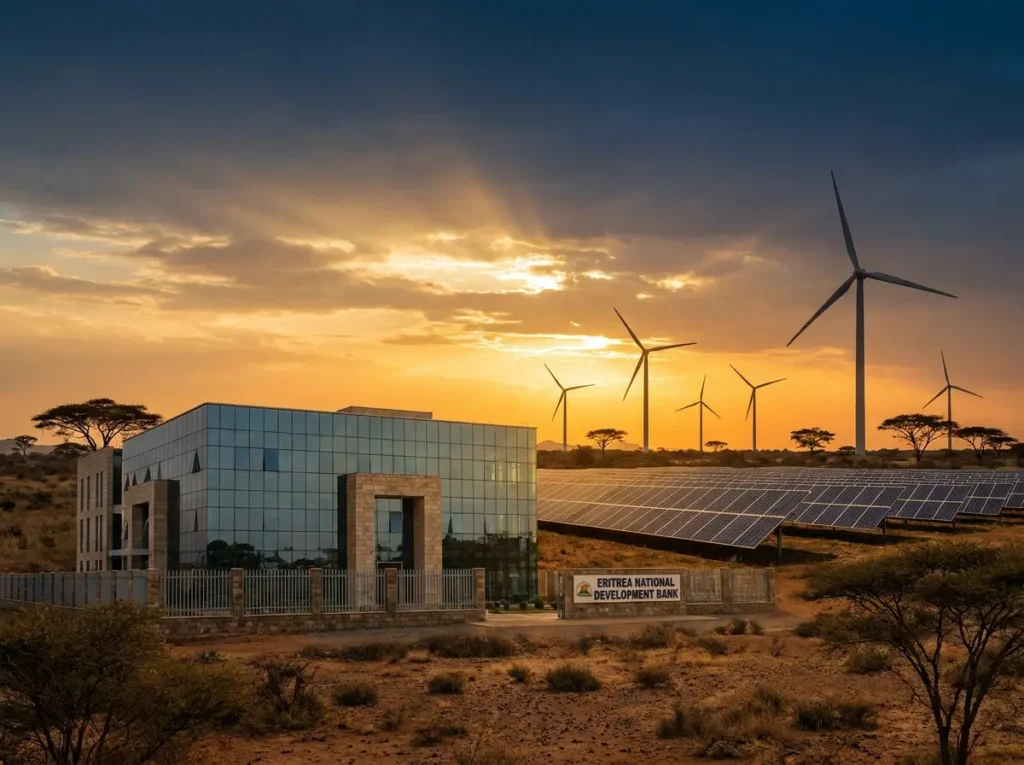
Modernising the Financial Architecture
No energy transition can succeed without the capital flows to fund it — and Eritrea’s financial sector remains the critical bottleneck. The African Development Bank’s analysis is unambiguous: the country’s banking system, characterised by state ownership and limited competitive dynamics, has suppressed domestic savings mobilisation, restricted credit availability to the private sector, and constrained the investment flows necessary to diversify an economy still heavily dependent on mineral exports.
The AfDB’s prescribed framework calls for a “gradual, well-sequenced expansion of private sector participation” in the financial system, alongside the modernisation of digital payment platforms. The introduction of mobile-enabled financial services and digital payment infrastructure carries transformative potential in a context where the informal economy accounts for an estimated 58% of total employment — a structural feature that currently restricts effective taxation and limits access to formal credit.
Broadening the tax base, expanding financial inclusion, and enhancing the regulatory environment are identified as the three pillars necessary to mobilise investment from domestic, diaspora, and foreign sources. Eritrea’s diaspora — concentrated in Europe, North America, and the Gulf — represents a substantial and largely untapped channel for productive capital inflows, contingent on the existence of formal, low-friction financial infrastructure to receive and deploy those resources.
The African Continental Free Trade Area (AfCFTA), the continent-wide trade integration framework, offers Eritrea a vehicle for deeper economic engagement and access to blended finance mechanisms. Participation in AfCFTA’s financial services protocols could catalyse the regulatory reforms needed to attract multilateral development bank lending — a category of financing from which Eritrea remains largely excluded due to outstanding sovereign obligations and data transparency constraints.
Eritrea’s current account position is notable: surpluses of 12.4% of GDP in 2024 and 13.2% in 2025, bolstered by gold exports from the Sheba Mine and stable import levels, suggest a degree of external resilience. Yet the challenge is not the balance of payments — it is the domestic transmission mechanism. A state-controlled financial sector cannot efficiently allocate even a favourable external position toward the productive investments that generate sustainable, broad-based growth.
Convergence and Outlook
The reform agenda facing Eritrea is both ambitious and achievable. The macroeconomic foundations — declining inflation, a stable exchange rate pegged at 15 Nakfa per US dollar, and manageable fiscal deficits — provide a credible platform. The international development community, from IRENA and UNEP to GIZ and the African Development Bank, has signalled sustained engagement. And the global economics of renewable energy have shifted so dramatically in favour of distributed solar and wind that the capital cost of clean electrification is now within reach of even the most resource-constrained economies, given appropriate concessional financing structures.
What Eritrea requires is the institutional scaffolding — transparent data systems, a regulatory environment conducive to private participation, and a modernised financial sector — to convert geopolitical goodwill and natural resource endowment into durable economic transformation.
For investors and development financiers monitoring frontier markets across the African continent, Eritrea represents a case study in latent potential: a nation where the fundamentals of a clean energy and financial modernisation pivot are in place, awaiting the institutional reforms and targeted capital deployment to bring them to fruition.
Established in 1964 and headquartered in Abidjan, Côte d’Ivoire, the African Development Bank Group is the premier multilateral development finance institution on the continent. Its mandate is to spur sustainable economic development and social progress across its 54 regional member countries. The AfDB deploys loans, equity investments, and technical assistance across infrastructure, agriculture, industry, finance, and social development, and produces authoritative economic research including the African Economic Outlook series.
UNEP is the leading global authority on the environment, established in 1972 and headquartered in Nairobi, Kenya. It sets the global environmental agenda, promotes the coherent implementation of the environmental dimension of sustainable development, and serves as an authoritative advocate for the global environment. In the energy space, UNEP implements programmes under the Global Environment Facility and supports nations in developing the climate reporting frameworks required under the UNFCCC.
The Global Environment Facility is an independent financial organization that provides grants and blended finance to developing countries for projects related to biodiversity, climate change, international waters, land degradation, and persistent organic pollutants. Established in 1991, the GEF has provided over $23 billion in grants and mobilized an additional $120 billion in co-financing for more than 5,000 projects in 170 countries. It serves as the financial mechanism for several major environmental conventions, including the UNFCCC.
GIZ is a German federal enterprise providing services in the field of international development cooperation. Operating in more than 120 countries, GIZ delivers technical assistance, advisory services, and capacity-building programmes on behalf of the German Federal Ministry for Economic Cooperation and Development (BMZ) and other commissioning parties including the European Union. Its work spans energy access, digital transformation, sustainable infrastructure, climate action, and governance reform. GIZ had revenues of approximately EUR 4.5 billion in 2024.
IRENA is an intergovernmental organization that supports countries in their transition to a sustainable energy future and serves as the principal platform for international cooperation on renewable energy. Founded in 2009 and headquartered in Abu Dhabi, UAE, IRENA facilitates the adoption of renewable energy through policy advice, capacity building, and the provision of data and analysis. It currently counts 168 member states and monitors renewable power capacity and generation data across all countries including Eritrea.
The International Energy Agency is an autonomous intergovernmental organization established in 1974, headquartered in Paris, France. Originally founded to coordinate responses to oil supply disruptions, the IEA has evolved into the global authority on energy statistics, policy analysis, and transition planning. The IEA tracks energy access, clean cooking, renewable capacity, and energy efficiency across all countries and publishes tracking reports under the Sustainable Development Goal 7 (SDG7) framework.
The African Continental Free Trade Area is a continental free trade agreement among 54 of the 55 African Union member states. Officially launched in 2019 and with its Secretariat based in Accra, Ghana, AfCFTA represents the world’s largest free trade area by the number of participating countries. The agreement aims to create a single market for goods and services, facilitate the movement of capital and persons, and lay the groundwork for a Continental Customs Union. AfCFTA’s financial services protocols are positioned to catalyse regulatory harmonisation and enable blended finance flows across member states.
Cosmopolitan The Daily is a global business publication delivering comprehensive coverage of Finance, Technology, Energy, Real Estate, and other key sectors across international markets. With offices spanning New York, Toronto, London, Dubai, Bangalore, Kuala Lumpur, and Sydney, the publication provides breaking news and in-depth market insights to directors and executives of leading companies worldwide.
Combining authoritative business journalism with an annual Business Excellence Awards programme, Cosmopolitan The Daily recognises innovation and value creation across industries and geographies. The publication’s truly international footprint enables it to deliver localised insights with global perspective, serving decision-makers who require comprehensive market intelligence from a single, trusted source.