The machines that train and run artificial intelligence are among the heaviest, most valuable and most closely watched pieces of cargo in global trade. One of the Middle East’s best-known logistics companies now wants to be the single party answerable for getting them where they need to go. Aramex, the Dubai Financial Market-listed group (DFM: ARMX), has introduced Aramex Data Center Logistics, a specialised service built around the equipment that goes into AI data centres, from the first transformer delivered to a construction site to the last AI rack placed in a data hall.
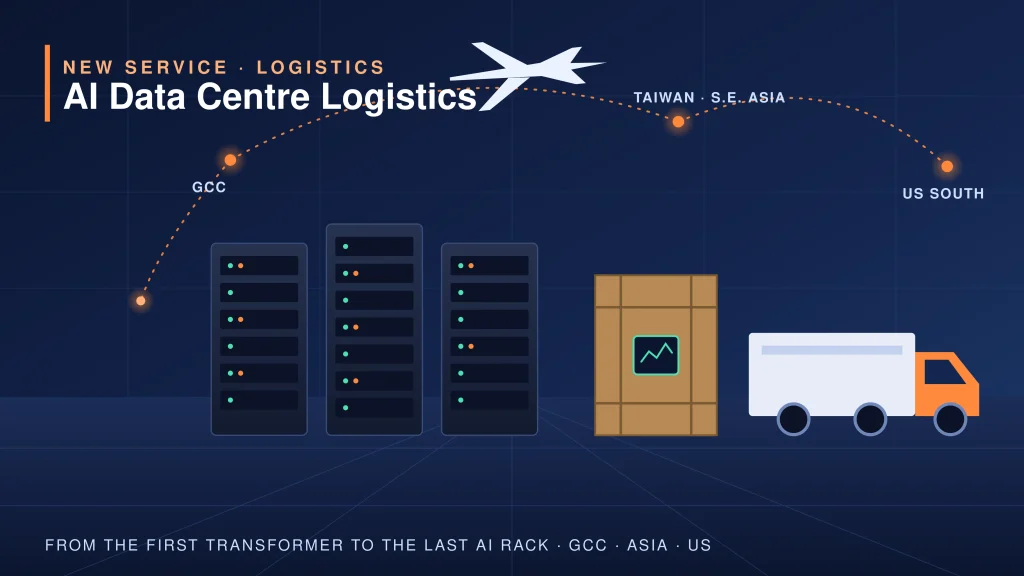
The service went live on 1 November 2026 and was announced publicly in the first days of the month. It begins in three corridors: the GCC, Southeast Asia and Taiwan, and the southern United States. Together they cover much of where AI hardware is manufactured and where many of the newest facilities are rising.
For an industry that has largely relied on a patchwork of forwarders, customs brokers and heavy-haul specialists, the pitch is simple: one team, one documented process, and one company accountable from the factory floor to a signed handover.
A service built for a very particular kind of cargo
Aramex Data Center Logistics is aimed at four groups of customers: data centre developers and operators, construction contractors, and manufacturers of power, cooling and computing equipment. Rather than offering a single shipping product, the company is proposing to take responsibility for the full journey of the equipment a facility needs, across its development and its operating life.
According to Aramex, the service is organised around four stages. The first is construction, covering transformers, switchgear, generators and chillers, including heavy and oversized loads. These items are tracked from the purchase order and delivered in step with the build schedule.
The second is compute. AI racks and network equipment are collected from factories in Taiwan, Southeast Asia, Mexico, the United States and Europe, then moved by charter flight or secure road transport, in line with customs and export-control requirements.
The third stage takes place inside the data centre itself, where Aramex staff handle the cargo at the loading dock, unpack it and place it in the data hall. The fourth is aftermarket support: spare parts, replacements and returns once the facility is live.
The breadth is the point. Many logistics providers can move a pallet of servers or a transformer. Far fewer are willing to promise they will stand behind the whole sequence.
Why AI infrastructure is not ordinary freight
The case for a specialist service rests on how unforgiving data centre construction has become. Aramex points out that transformers and chillers can take a year or more to travel from order to site, and that they must arrive in step with construction. A cooling plant that turns up months before the building is ready creates storage and handling headaches. One that turns up late can hold up an entire project.
The computing equipment raises the stakes further. According to the company, a single crated AI rack weighs around 1.75 metric tonnes and is worth several million dollars. It is also export-controlled, and it can be damaged in transit without any visible mark on the crate. That combination of weight, value, regulatory sensitivity and hidden fragility is unusual even among high-end cargo.
Then there is the question of who is responsible. Aramex notes that these deliveries are often divided among separate forwarders, customs brokers, heavy-haul firms and installers, with nobody accountable for the whole journey. When something goes wrong, the finger-pointing can begin before the cargo has even cleared the dock. One late or damaged shipment, the company says, can push back the day a data centre goes live.
For developers and operators, that go-live date is not an abstract milestone. AI capacity is built to demanding timetables, and a facility that is ready but empty, or half-equipped, represents money sitting idle. Anything that shortens the chain of handoffs and clarifies who owns a problem has obvious appeal.
Sensors in the crate, a signature at the end
One of the more concrete features of the new service is how Aramex says it will handle the racks. Every AI rack, the company says, travels under a single documented process, with sensors sealed inside the crate that track shock, tilt, temperature and humidity from the factory to a signed handover at the data centre.
Those four measurements map neatly onto the risks the company describes. A rough lift or a dropped crate registers as shock. A rack tipped during loading shows up as tilt. Temperature and humidity matter for sensitive electronics crossing climates as different as Taiwan’s and the Gulf’s.
The practical value is as much about evidence as prevention. A continuous record from factory to data hall gives customers, manufacturers and, potentially, insurers a clearer picture of what happened to a shipment and when. In a business where damage may not be visible, data can settle questions that a visual inspection cannot. The signed handover at the end closes the loop, marking a clear point at which responsibility passes to the customer.
A map drawn around the AI build-out
The launch geography is telling. Aramex describes a corridor running from Abu Dhabi and Riyadh to Johor, Texas and Louisiana. Each name stands for a different part of the AI infrastructure story.
In the Gulf, governments and investors have made AI and data infrastructure a strategic priority, and the cities named by Aramex sit at the centre of that ambition. Johor, in southern Malaysia, has become a magnet for data centre development in Southeast Asia, benefiting from its proximity to Singapore. Texas and Louisiana represent the southern United States, where large facilities are being planned and built.
On the supply side, Aramex says it has teams in Taiwan, Malaysia, Singapore, the United States and Europe who work directly with the factories that build the equipment. Taiwan is a major centre of server and electronics manufacturing, while the company also names sources in Southeast Asia, Mexico, the US and Europe. The result is a service that touches both ends of the journey: the plants where racks and power equipment are made, and the sites where they are installed.
That two-ended presence is central to Aramex’s argument. As the company puts it, one business answers for the cargo at both ends, rather than handing it between unrelated partners at each border.
Four decades of experience, repackaged for a new customer
Aramex is not building the capability from nothing. The new service draws on more than four decades of experience in freight forwarding, customs clearance and project logistics. Those disciplines, long used for industrial and infrastructure projects, translate readily to the demands of data centre construction, where heavy equipment, tight schedules and cross-border paperwork are the norm.
In the GCC, the company says it operates the region’s largest logistics network, with more than 7,000 people and its own stations, warehouses, trucks and customs teams in every market. Owning that last-mile and customs infrastructure, rather than subcontracting it, is what allows Aramex to claim end-to-end accountability in the region where much of the new capacity is planned.
The approach also reflects a wider shift in logistics, where customers increasingly want industry-specific services rather than generic transport. Healthcare, for instance, has seen Aramex open a regional hub at Dubai South Free Zone to serve compliant, patient-focused logistics. Data centres, with their own regulatory and technical demands, look like another vertical where specialisation can justify a dedicated offering.
“A data center is only as fast as its slowest delivery”
Aramex Group Chief Executive Officer Amadou Diallo framed the launch around the unforgiving nature of AI build schedules. The companies building AI capacity, he said, work to dates that cannot move, with equipment made on one continent and installed on another.
Moving that cargo across borders, on time and intact, is exactly what Aramex is built for, in his words, and the new service puts that strength behind what he called one of the most demanding build-outs of our time. He described the launch as an important step in the company’s growth as a global logistics business.
The comment captures the commercial logic. If the slowest delivery sets the pace for the entire project, then the value of logistics is measured not in the cost of moving any single item but in the cost of delay across the whole build. A provider that can reliably synchronise dozens of deliveries is, in effect, selling schedule certainty.
Part of a larger repositioning
The launch comes after a year in which Aramex has talked up its own use of AI. In February 2026, the company announced an AI-first global data foundation built on Google Cloud, a lakehouse architecture meant to replace legacy systems and create what it described as a single source of truth for its worldwide operations. Chief Technology Officer Françoise Russo said at the time that data is the fuel of modern logistics and that its value lies in how it is used.
There is a certain symmetry in a company that is rebuilding its own operations around AI now moving the hardware that AI depends on. The data foundation is about making Aramex’s network smarter. The data centre service is about making Aramex essential to those building the infrastructure for the technology.
The company’s leadership has also been vocal about the region’s growing importance. In an interview published by Khaleej Times on 2 November, the chief executive said he sees the centre of logistics shifting to the Middle East. In his telling, it was concentrated in Singapore and later in Shanghai, and is now moving as Asian manufacturers relocate production to Saudi Arabia, the UAE, Egypt and Morocco. A service that links Gulf construction sites to Asian and American factories fits neatly inside that narrative.
What to watch
The announcement leaves several questions open, as launches often do. The company has not named customers or published financial targets for the service, and it has not detailed how it will price what is, in effect, a bundle of freight, handling and risk management. Analysts and prospective clients will want to see how quickly the offering converts from a promise into signed contracts.
Execution will be the real test. Chartering aircraft and coordinating secure road moves for multimillion-dollar, export-controlled equipment requires tight discipline, and regulatory regimes can change quickly. Compliance with customs and export controls across several jurisdictions is a stated feature of the service, and it will be scrutinised accordingly.
Competition is another factor. Global forwarders and specialist heavy-haul and project-cargo firms already serve parts of the data centre supply chain, and some may respond with their own bundled offerings. Aramex’s advantage, if it holds, will lie in its regional footprint in the Gulf and its direct relationships with manufacturers in Asia.
Finally, there is the question of demand. The service is built on the assumption that AI infrastructure investment will continue at pace across the three launch regions. Customers, for their part, will judge the offer on a simple measure: whether racks and power equipment arrive undamaged, on schedule and with a clean paper trail.
The bottom line
In the race to build AI capacity, attention tends to fall on chips, models and the companies that design them. Aramex’s launch is a reminder that the physical world still sets the pace. Transformers must be shipped, chillers must be installed, and racks weighing well over a tonne must be moved safely across oceans and borders before a single query can be answered.
By putting a dedicated team and a documented process behind that journey, Aramex is betting that data centre builders will pay for a single point of accountability. If the bet pays off, the company will have turned its long experience in freight, customs and project logistics into a foothold in one of the fastest-moving construction cycles anywhere. If it does not, it will still have sharpened a message that resonates well beyond data centres: in a world built to deadlines, the slowest delivery sets the speed for everyone.
Founded in 1982, Aramex is a global provider of comprehensive logistics and transportation solutions for businesses and consumers. Listed on the Dubai Financial Market since 2005 and headquartered in the UAE, the company is strategically positioned to bridge East and West. With operations in more than 600 cities across 70 countries, Aramex employs over 16,000 professionals. Its services are organised around four business products: International Express, which includes its parcel-forwarding businesses Shop & Ship and MyUS; Domestic Express; Freight Forwarding; and Logistics & Supply Chain Solutions.
Cosmopolitan the Daily is a digital news and lifestyle publication delivering timely reporting, analysis and features to a modern, globally minded readership. Covering business, technology and the stories shaping everyday life, it aims to make complex developments accessible, engaging and relevant. Its newsroom is committed to accuracy, fairness and clear storytelling, bringing readers the news that matters every day.