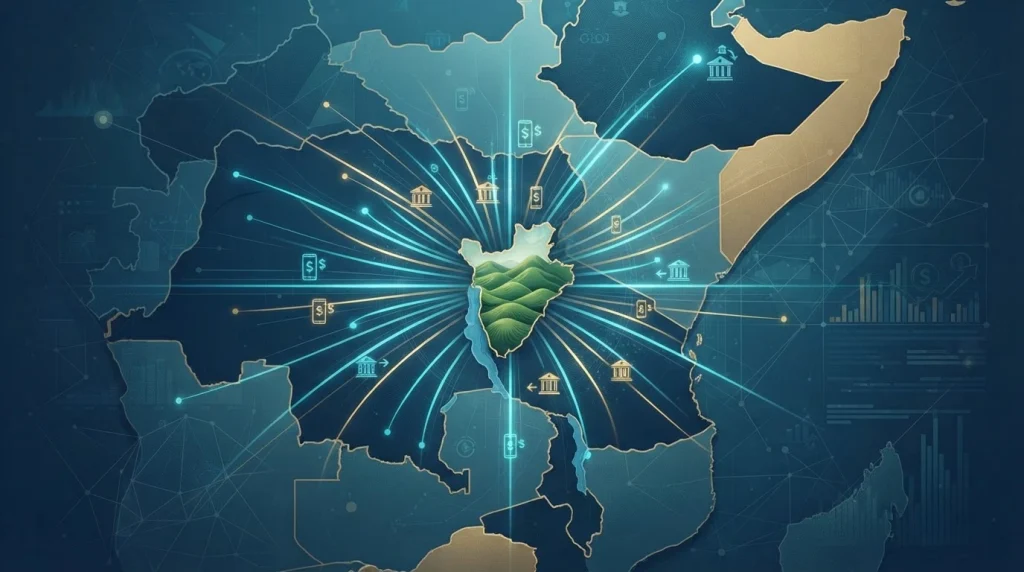
Burundi is set to join the East African Payment System (EAPS), a regional initiative designed to make payments between participating East African countries more direct and efficient. The move could strengthen financial links across the region, where families, businesses, and public institutions regularly need to send and receive money across national borders.
A regional payment connection may sound like a technical development, but its effects can be felt in everyday life. When payment systems are better connected, a business importing goods from a neighboring country may be able to settle an invoice more smoothly. A family supporting relatives across a border could benefit from a more convenient way to transfer money. And banks may have a shared framework for processing certain regional payments.
Those outcomes are not automatic. The value of Burundi’s participation will depend on the system’s implementation: which institutions connect, how transactions are processed, what fees apply, and how reliably the service works. The announcement is therefore best understood as an important step—not, by itself, a guarantee of cheaper or faster payments for every user.
What is the East African Payment System?
The EAPS is a regional payment arrangement intended to connect participating countries’ national payment infrastructures. In practical terms, this can help financial institutions process cross-border payments through established banking channels rather than relying only on more complicated or indirect routes.
The system is associated with the East African Community’s wider effort to deepen regional integration. That effort includes cooperation on trade, movement of people, financial services, and economic policy. Payments are a central part of that picture: goods cannot move easily if it is difficult to pay suppliers, and regional businesses cannot expand smoothly if collecting money across borders is slow or uncertain.
A cross-border payment involves more than sending money from one account to another. Financial institutions must confirm the sender’s instructions, check that the transaction meets relevant rules, communicate with other institutions, and settle the funds. Different countries may use different currencies, operating hours, technical standards, and compliance procedures. A shared system can provide a more organized way to handle some of those steps.
That does not mean every payment will become instant, or that every person will be able to use the system directly. EAPS operates through participating financial institutions and national payment arrangements. How individuals and businesses experience it will depend on the services their banks and other providers make available.
Why Burundi’s participation matters
Burundi’s planned connection matters because regional systems become more useful as they bring together more economies and financial institutions. If the country’s institutions are successfully integrated, businesses and organizations may have another route for making payments with counterparts in participating markets.
Burundi’s economic ties with its neighbors span trade, transport, agriculture, services, and family connections. Small businesses may need to pay suppliers or receive money from customers abroad. Larger firms may handle recurring invoices, logistics expenses, and other transactions that cross national boundaries. Public institutions also coordinate with regional partners on programs and services.
For those activities, the process behind a payment can affect planning and cash flow. A transfer that takes longer than expected may delay a shipment or make it harder for a business to manage its available funds. A payment route with unclear charges can make it difficult to estimate the true cost of a transaction. Improving payment connections can help address some of these frictions, provided the system is accessible and dependable.
The benefits could be especially relevant for smaller firms. Large companies often have dedicated finance teams and established banking relationships to manage international transactions. Smaller businesses may have fewer options and less room to absorb delays or fees. A more connected regional payments framework could help widen access to formal cross-border transactions—but only if banks and service providers offer practical, affordable products to smaller customers.
For households, the impact may be less visible than a new app or a dramatic change to banking. A regional system does not necessarily create a new consumer-facing service on its own. Instead, it may improve the infrastructure that financial institutions use behind the scenes. Whether families notice a difference will depend on the options offered by their bank or payment provider.
The opportunity—and the conditions behind it
A well-implemented regional payment connection can offer several potential advantages. It may make payment processing more straightforward for participating institutions, support faster settlement in some cases, and reduce dependence on multiple intermediaries. It may also help financial institutions provide more predictable services to customers making eligible cross-border payments.
But these are potential outcomes, not guaranteed results. The actual experience will depend on the system’s operating rules and the institutions connected to it. Customers will still need clear information about transfer times, exchange rates, charges, transaction limits, and how to resolve a payment problem.
The exchange-rate question is particularly important. A payment that crosses currency zones may require a conversion, and the rate applied can affect how much the recipient ultimately receives. The payment network itself does not necessarily determine the price a customer pays for currency conversion. Banks and providers may apply their own rates or fees, subject to relevant rules and disclosures.
There is also the question of coverage. A regional system can connect national infrastructures, but that does not automatically mean that every bank, business, or individual is connected. Participation may begin with a limited group of institutions before expanding. The range of available services may also differ by provider.
For the network to build trust, users need to know what to expect before they send money. That includes the total cost, the estimated delivery time, the information required from the sender, and the process for correcting errors. Clear customer support matters, too. If a payment is delayed or sent incorrectly, users need a reliable way to find out what happened and what steps are available.
What businesses should look for
Businesses watching Burundi’s entry into the EAPS should focus on operational details rather than assuming that the change will immediately transform cross-border trade. The most useful questions include:
- Which banks and payment providers will participate, and when will their services become available?
- What types of payments will be supported, including business transfers, payroll, and payments to suppliers?
- How will fees and currency conversion work, and will customers receive clear information before confirming a transaction?
- What are the expected processing times, including the effects of weekends, public holidays, and compliance checks?
- How will disputes and failed payments be handled, and which institution will customers contact?
The answers will help companies decide whether and how to incorporate the new payment option into their day-to-day operations. Businesses may also need to review internal procedures, update supplier instructions, and train finance teams to handle the new route.
For companies already making cross-border payments, the arrival of an additional channel could create more choice. Yet choice is useful only when the options are understandable and dependable. Firms will want to compare the full cost and service terms of available methods rather than assuming that a regional connection is automatically the least expensive route.
What customers should know
Individuals should wait for their banks or payment providers to explain whether and how they can use services supported by the EAPS. The system’s regional role does not necessarily mean that customers need to take any action immediately—or that a new service will appear in their banking app as soon as Burundi joins.
When a provider announces an eligible cross-border service, customers should check the recipient details carefully, review any fees and exchange rates, and confirm how long the transfer may take. They should also keep the transaction reference and contact the provider through official channels if a payment does not arrive as expected.
Digital payments can make transactions more convenient, but safe use remains important. Customers should protect account credentials, avoid sharing verification codes, and be cautious of messages that claim to offer early access or request payment to activate a transfer service. Official announcements should come from recognized financial institutions and relevant public authorities.
Integration is more than technology
Connecting payment infrastructures requires technical coordination, but regional financial integration also depends on rules, oversight, and cooperation. Institutions need to agree on processes for handling transactions and addressing operational problems. They must also maintain appropriate safeguards against fraud, financial crime, and system disruptions.
Cybersecurity is an ongoing responsibility for every institution involved in digital payments. As networks become more connected, the security of each participating institution matters to the wider system. Strong controls, regular testing, incident-response plans, and clear communication can help protect both financial institutions and the people who rely on them.
Reliability matters just as much. Businesses and households need payment services to work consistently, not only during a launch period or under ideal conditions. Institutions will need to monitor performance, identify bottlenecks, and communicate about outages or delays. Public confidence will grow through dependable service and transparent information.
There is also a broader policy challenge: ensuring that formal payment improvements reach people and businesses that have traditionally faced barriers to financial services. A regional system may improve the connections between institutions, but access still depends on practical factors such as account ownership, service availability, digital literacy, identification requirements, and cost.
A regional step with local consequences
Burundi’s planned participation in the EAPS represents a meaningful development in the ongoing effort to connect East Africa’s financial systems. It reflects a simple but important idea: regional trade and mobility work better when money can move with fewer obstacles.
The strongest impact may come gradually. Financial institutions will need to connect and test their services. Businesses will need to understand the available payment routes. Customers will need clear guidance about what has changed—and what has not. Over time, improvements in the underlying payment infrastructure could support more convenient transactions across borders.
For now, the key measure of success will be practical: whether participating institutions can provide secure, reliable, transparent, and accessible services. If Burundi’s connection delivers on those fundamentals, it could help support trade, strengthen financial cooperation, and make certain regional payments easier to manage.
The next details to watch are the official implementation timeline, the institutions expected to participate, and the services customers can actually use. Those specifics will determine whether this regional milestone remains primarily an infrastructure development or becomes a noticeable improvement in the way people and businesses move money across East Africa.
East African Payment System (EAPS): A regional payment arrangement designed to support cross-border payments through connections between participating national payment infrastructures. It is a system, not a company.
East African Community (EAC): A regional intergovernmental organization whose partner states cooperate on economic, political, and social integration. The EAC’s initiatives include efforts to strengthen regional trade and cooperation.
Banque de la République du Burundi (BRB): Burundi’s central bank, responsible for central banking functions and oversight within the country’s financial system. Confirm with the BRB for official information about Burundi’s participation and implementation plans.
Cosmopolitan The Daily: A digital publication presenting news and information to its readership. This article should be updated with the publication’s verified corporate description, ownership details, and editorial contact information before posting.