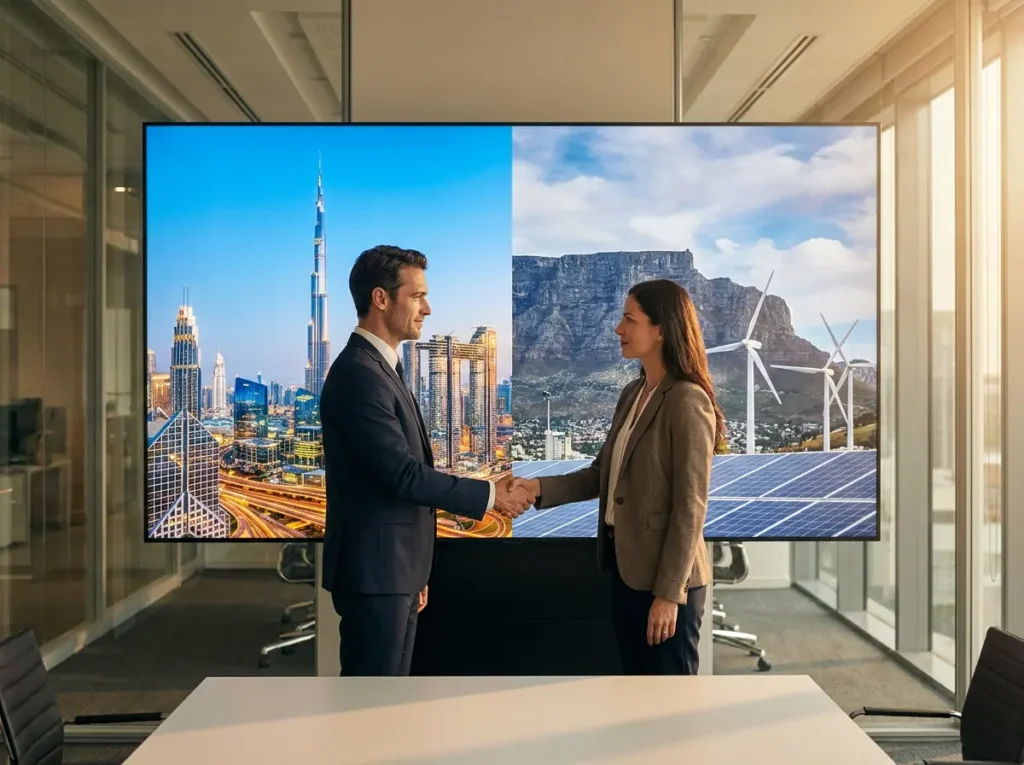
South Africa is mounting a concerted diplomatic and commercial push to deepen renewable energy investment ties with the United Arab Emirates, as Pretoria looks to the Gulf’s sovereign-backed clean energy champions to help close one of the world’s most pressing infrastructure gaps.
The bid is gaining measurable traction. UAE investments in South Africa surpassed $1.3 billion in 2024, according to figures released by the UAE Ministry of Foreign Affairs — and that figure is widely expected to grow materially as the energy transition accelerates and Emirati conglomerates expand their African mandates.
A Strategic Relationship Forged at the Summit Level
The bilateral momentum crystallised in January 2026 when President Cyril Ramaphosa travelled to Abu Dhabi to participate in Abu Dhabi Sustainability Week (ADSW 2026), one of the world’s largest annual gatherings on clean energy and sustainable development. On the sidelines, Presidents Ramaphosa and Sheikh Mohamed bin Zayed Al Nahyan held bilateral talks focused explicitly on renewable energy cooperation, logistics, and transport.
Ramaphosa’s presence at a heads-of-state fireside chat themed “A Vision for Global Energy” sent an unambiguous signal to Emirati capital: South Africa is open, committed, and actively competing for Gulf investment in its energy sector.
“The visit aims to deepen South Africa–UAE economic ties and attract investment in renewable energy, logistics, and transport,” the South African Presidency confirmed in a statement released alongside the delegation’s arrival in Abu Dhabi.
The messaging has been consistent across forums. At the 2026 South Africa Investment Conference (SAIC), clean energy was named a primary investment focus, with the government underscoring the scale of opportunity available to international capital — particularly from partners with the technical and financial depth of the UAE.
The UAE’s Africa Renewable Playbook — and Where South Africa Fits
The UAE’s interest in African renewables is not incidental. Between 2019 and 2023, Emirati companies announced $110 billion in projects across Africa, with $72 billion — approximately 65% — directed specifically at renewable energy, according to data from FT Locations. That positions the UAE as Africa’s largest single foreign investor in the clean energy space, outpacing traditional economic powers including China, France, and the United States.
South Africa sits at the centre of this strategy. The country’s combination of abundant solar and wind resources, an established regulatory framework for independent power producers (IPPs), and a creditworthy offtake ecosystem makes it among the most commercially viable renewable energy destinations on the continent.
Three Emirati entities have emerged as the primary vectors of this capital into South Africa’s energy market: Masdar, AMEA Power, and TAQA.
Masdar’s Continental Mandate
Abu Dhabi’s Masdar — one of the world’s largest clean energy companies — has committed $10 billion to deliver 10 gigawatts of renewable capacity across sub-Saharan Africa by 2030. South Africa is a core component of that plan.
Masdar’s global portfolio has already crossed the 51 GW milestone, with projects spanning more than 40 countries across six continents. In 2025 alone, the company made investments “worth $15 billion” in renewable energy projects globally, reinforcing its position as a first-mover in markets that other international developers often hesitate to enter.
In South Africa, Masdar is pursuing utility-scale solar photovoltaic and battery energy storage projects through structured public-private partnerships, targeting grid stabilisation alongside capacity expansion — a dual objective that aligns closely with South Africa’s critical need to address both chronic load-shedding and long-term baseload reliability.
AMEA Power: Boots on the Ground
Dubai-headquartered AMEA Power has already translated ambition into operational capacity in South Africa. The company holds a clean energy pipeline of over 6 GW across 20 countries and has deepened its South African presence through two landmark projects.
In 2023, AMEA Power signed a 25-year Power Purchase Agreement (PPA) with Africa GreenCo for the Rooidraai 85MW solar PV plant, located in the North West Province. Standard Bank was appointed to finance the construction — a structuring that exemplifies the hybrid capital approach increasingly common in African energy deals.
More recently, AMEA Power commissioned the Doornhoek 120 MW solar PV project, making it the first plant to operate under South Africa’s Renewable Energy Independent Power Producer Procurement Programme (REIPPPP) Bid Window 6. The Doornhoek project secured $108 million in project financing and marks a significant operational milestone for UAE-backed renewable development in the country.
AMEA Power has confirmed it has secured sites in South Africa suitable for more than 1 GW of additional capacity, signalling that its current South African portfolio is a foundation, not a ceiling.
TAQA’s Strategic Positioning
Abu Dhabi National Energy Company (TAQA), one of the UAE’s largest government-controlled energy conglomerates, is also expanding its African footprint, with South Africa among its target markets. TAQA reported full-year 2025 revenues of AED 54.8 billion and a 5.6% rise in net income to AED 7.5 billion, providing the financial firepower to pursue significant project development across emerging markets.
The company’s renewable energy division has been growing rapidly, and its Africa strategy forms part of a broader mandate to diversify beyond TAQA’s traditional oil and gas assets. Projects in Morocco, Senegal, and South Africa reflect a deliberate tier-one market prioritisation — countries with the regulatory stability and demand volumes required to underwrite long-term capital commitments.
GreenCo: The Private Offtake Bridge
Enabling this wave of UAE investment is Africa GreenCo, the continent’s first private cross-border energy trader, whose South African subsidiary GreenCo Power Services has emerged as a critical market infrastructure player.
The 25-year PPA between GreenCo and AMEA Power’s Rooidraai plant demonstrated that bankable, long-tenor offtake agreements can be structured outside of the traditional state utility framework — a precedent with significant implications for accelerating private capital deployment across South Africa’s renewable sector.
The Investment Imperative
The strategic logic driving South Africa’s pursuit of UAE capital is stark. The country faces a structural electricity deficit that has constrained GDP growth for more than a decade. The government’s Integrated Resource Plan (IRP) calls for the addition of tens of gigawatts of new renewable capacity by 2030, requiring investment volumes that domestic capital markets alone cannot supply.
The UAE, for its part, brings not only capital but sovereign credibility, project development expertise across complex emerging markets, and a political alignment forged through years of South-South diplomatic engagement. For Emirati clean energy champions such as Masdar and AMEA Power, South Africa offers among the most compelling risk-return profiles on the continent — solar irradiance among the world’s highest, a sophisticated banking sector capable of co-financing, and an IPP framework with a track record of closed transactions.
The convergence of need and capacity is producing a pipeline that industry observers describe as structurally significant — and still in early innings.
Outlook
With President Ramaphosa having personally championed the bilateral relationship at the highest levels, and with UAE companies already commissioning operating assets, the relationship between South Africa and the UAE in renewable energy has moved decisively from dialogue to deployment.
The outstanding question is one of scale and speed. South Africa needs tens of billions of dollars and thousands of megawatts. The UAE has the capital, the companies, and the political will. Whether the regulatory environment, grid infrastructure, and project pipeline can absorb that capital at the pace both sides want will define the next chapter of one of Africa’s most consequential energy partnerships.
Masdar is one of the world’s largest clean energy companies and a global leader in renewable energy development and sustainability. Headquartered in Abu Dhabi and majority-owned by Abu Dhabi National Energy Company (TAQA), Mubadala Investment Company, and Abu Dhabi National Oil Company (ADNOC), Masdar has developed projects in more than 40 countries across six continents with a combined capacity exceeding 51 gigawatts. The company’s portfolio spans solar, wind, geothermal, waste-to-energy, and battery storage technologies. Masdar has committed $10 billion to deliver 10 GW of renewable energy across sub-Saharan Africa by 2030, cementing its position as the continent’s most ambitious single clean energy investor.
AMEA Power is a Dubai-headquartered renewable energy developer, owner, and operator active across Africa, the Middle East, and Asia. The company manages a clean energy pipeline of over 6 GW across more than 20 countries, with operations spanning solar photovoltaic, wind, and battery energy storage. In South Africa, AMEA Power is one of the most active Emirati developers, with the operational Doornhoek 120 MW solar PV project — the first commissioned under REIPPPP Bid Window 6 — and the 85 MW Rooidraai solar plant under a 25-year PPA with Africa GreenCo. AMEA Power has identified sites in South Africa with pipeline potential exceeding 1 GW.
TAQA is Abu Dhabi’s government-controlled energy holding company and one of the largest diversified energy conglomerates in the Middle East. With 2025 revenues of AED 54.8 billion and operations spanning power generation, water desalination, oil and gas exploration, and energy transmission across multiple continents, TAQA is a cornerstone of the UAE’s energy-to-clean-energy transition. The company holds majority stakes in Masdar alongside Mubadala and ADNOC, and is expanding its direct presence in African renewable energy markets, including South Africa, as part of a strategic diversification away from fossil fuel assets.
Africa GreenCo is the African continent’s first private cross-border energy trader, established to accelerate private sector investment in sub-Saharan African power markets by providing bankable, long-tenor offtake agreements to independent power producers. Its South African subsidiary, GreenCo Power Services, has signed a landmark 25-year Power Purchase Agreement with AMEA Power for the 85 MW Rooidraai solar PV plant in North West Province — demonstrating a replicable model for unlocking renewable energy development outside traditional state utility frameworks. Africa GreenCo is backed by the Private Infrastructure Development Group (PIDG) and a consortium of development finance institutions.
Standard Bank Group is Africa’s largest bank by assets, headquartered in Johannesburg, South Africa. With a presence in more than 20 African countries and a growing global footprint, Standard Bank provides corporate and investment banking, retail and business banking, wealth management, and insurance services. In the energy sector, Standard Bank has established itself as a leading project finance arranger for renewable energy transactions across the continent, including as the appointed financier for AMEA Power’s 85 MW Rooidraai solar project in South Africa. The bank plays a pivotal role in bridging international capital — including from UAE investors — with viable African energy infrastructure projects.
Cosmopolitan The Daily is a global business publication delivering comprehensive news coverage and in-depth market intelligence across Finance, Technology, Energy, and Real Estate sectors. With offices in New York, Toronto, London, Dubai, Bangalore, Kuala Lumpur, and Sydney, the publication serves a readership of directors, executives, and senior decision-makers at leading companies worldwide. In addition to its daily editorial output, Cosmopolitan The Daily operates the annual Business Excellence Awards programme, recognising innovation and value creation across industries and geographies. The publication is committed to original, authoritative reporting that provides its international audience with the insights required to navigate the global business environment.