The Dutch Entrepreneurial Development Bank (FMO) has agreed to provide a dedicated financing package to Solarcentury Africa Limited, channeling capital into an ambitious programme of solar energy development across three of sub-Saharan Africa’s most strategically significant markets: Zambia, Namibia, and Botswana.
The transaction represents one of the most targeted interventions by a major European development finance institution into Southern Africa’s renewable energy corridor, where rapid population growth, rising industrial demand, and longstanding grid deficiencies have combined to create a compelling case for utility-scale solar investment.
A Region Ready for Transformation
Southern Africa has long been identified as one of the most promising solar markets on the continent. The region receives some of the highest levels of solar irradiation globally, yet access to reliable electricity — particularly in rural and peri-urban communities — remains a persistent constraint on economic development.
In Zambia, chronic power shortages have hampered industrial output and dampened foreign direct investment, despite the country’s rich endowment of natural resources. Namibia, meanwhile, has set an ambitious target to become a net exporter of green energy, with solar underpinning the government’s broader hydrogen export strategy. Botswana, one of Africa’s most politically stable economies, is actively diversifying its power mix away from coal dependency as part of its long-term sustainable development agenda.
Solarcentury Africa’s expansion into all three markets simultaneously reflects both the scale of opportunity and the confidence that established developers now bring to the region.
FMO’s Strategic Rationale
For FMO, the investment aligns with its mandate to support private sector development in emerging and frontier markets, with a particular emphasis on climate finance and energy access. The bank has increasingly positioned itself as a lead financier for renewable projects across sub-Saharan Africa, leveraging its relationships with local financial institutions, development partners, and project developers to mobilise capital at scale.
The financing package for Solarcentury Africa is structured to support project development, construction, and operational phases — providing the long-term capital certainty that solar developers require to negotiate power purchase agreements, secure land rights, and procure equipment in markets where local commercial lending remains costly and short-tenured.
FMO’s involvement is also expected to catalyse co-financing from other international development finance institutions and private sector lenders, a pattern well established in the bank’s existing African portfolio.
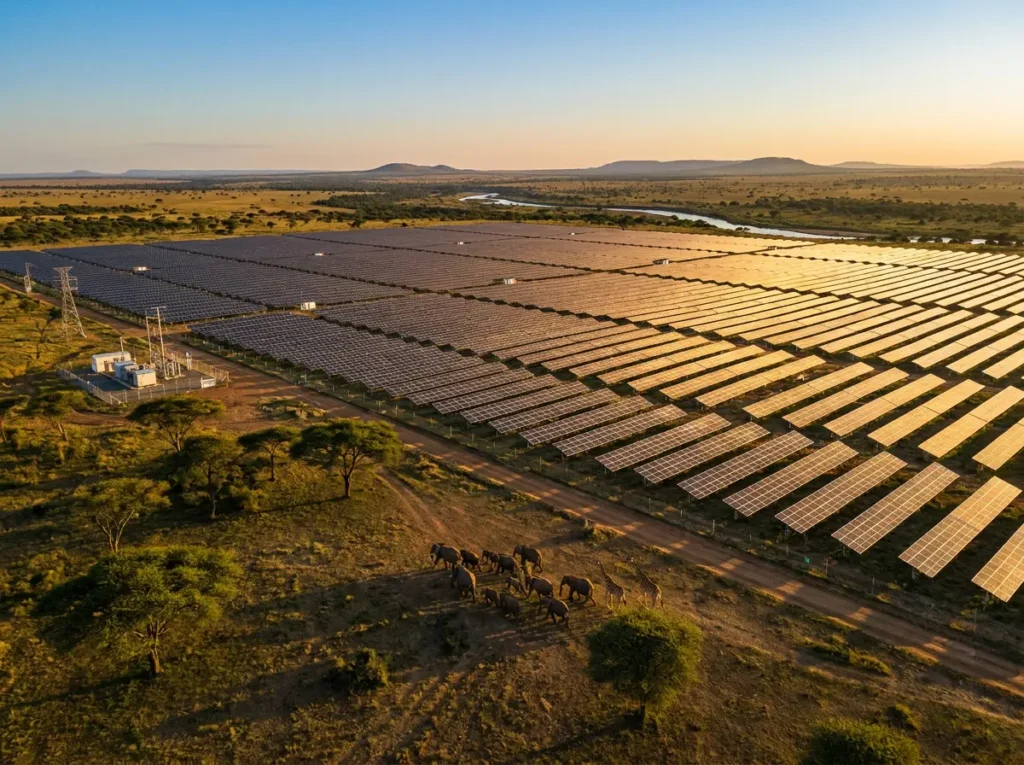
Solarcentury Africa’s Expansion Blueprint
Solarcentury Africa has built a reputation across the continent for developing technically complex solar projects in challenging operating environments. With the FMO financing in place, the company is positioned to accelerate a pipeline of projects that have been in advanced development across the three target markets.
The projects are expected to generate significant installed capacity, contributing meaningfully to national electricity generation in each country. Beyond direct energy output, the developments are projected to create local employment during construction and operations, stimulate demand for local goods and services, and — in Zambia and Namibia in particular — support the electrification of communities that remain off-grid.
Implications for the Southern African Energy Market
The FMO–Solarcentury Africa financing deal arrives at a pivotal moment for the Southern African Power Pool (SAPP), the regional electricity trading mechanism that spans twelve member states. Years of underinvestment in generation capacity have left the region with a structural power deficit that conventional thermal generation alone cannot resolve within acceptable environmental and economic parameters.
Solar has emerged as the fastest, most cost-effective solution to that deficit. The levelised cost of solar electricity in the region now compares favourably with legacy coal generation on a whole-of-life basis, and international development capital has played a central role in bridging the financing gap that has historically prevented projects from reaching financial close.
Transactions of this nature send a clear signal to other developers and financiers that the Southern African market is open, bankable, and capable of absorbing the kind of capital commitments required to deliver transformational energy infrastructure.
FMO is the Dutch development bank, owned by the Dutch government (51%), a consortium of Dutch banks (42%), and trade unions and individual investors (7%). Headquartered in The Hague, Netherlands, FMO provides long-term financing to private sector enterprises in developing countries and emerging markets across the globe.
With a portfolio of EUR 14 billion and investments spanning more than 85 countries, FMO focuses its capital deployment on three primary sectors: Financial Institutions, Energy, and Agribusiness, Food & Water. The bank is committed to supporting the transition to a low-carbon economy and to creating measurable development impact through its investments. In Africa, FMO has a long track record of financing renewable energy projects, infrastructure, and private sector growth, working closely with governments, multilateral institutions, and development finance partners.
Solarcentury Africa Limited is the African subsidiary of Solarcentury, one of the world’s leading solar energy companies. Established to bring Solarcentury’s decades of solar development expertise to the African continent, the company specialises in the development, financing, construction, and operation of utility-scale solar photovoltaic projects across sub-Saharan Africa.
Solarcentury Africa operates across multiple African markets, with a focus on delivering reliable, affordable, and clean electricity to businesses, communities, and national grids. The company works closely with host governments, national utilities, and international financing institutions to bring technically robust and financially bankable projects to operational status. Its approach combines international best practice in project development with deep local knowledge and stakeholder engagement, ensuring projects deliver lasting benefit to the communities and economies in which they operate.
Cosmopolitan The Daily is a global business publication delivering comprehensive news coverage and in-depth market analysis across Finance, Technology, Energy, and Real Estate sectors. With editorial offices in New York, London, Dubai, Bangalore, Toronto, Kuala Lumpur, and Sydney, the publication serves an international readership of senior executives, directors, and decision-makers at leading companies worldwide.
Cosmopolitan The Daily combines rigorous, original reporting with a global perspective, providing business leaders with the intelligence they need to navigate complex and rapidly evolving markets. The publication also hosts the annual Business Excellence Awards, recognising innovation and exceptional performance by companies across sectors and geographies.