In the middle of the Atlantic, Cabo Verde occupies a position that is easy to overlook on a map and difficult to ignore when thinking about connections between continents. The island nation lies off the coast of West Africa, within reach of European and South American markets. That geography could give it a larger role in the digital economy—one that extends beyond providing a landing point for cables to helping shape a more direct South Atlantic route for data.
The opportunity is attracting attention as technology companies, telecommunications operators and investors look for ways to move information reliably between Europe, Africa and Latin America. Growing demand for cloud computing, video, artificial intelligence and cross-border business services is increasing the need for high-capacity international connections. At the same time, companies and governments are seeking networks that are resilient, diverse and less dependent on a small number of established routes.
Cabo Verde could be part of that picture. But geography alone will not make the country a digital gateway. Turning potential into lasting economic value will depend on cable investment, dependable power, competitive connectivity, skilled workers, clear regulation and partnerships that benefit local communities.
Why the South Atlantic matters
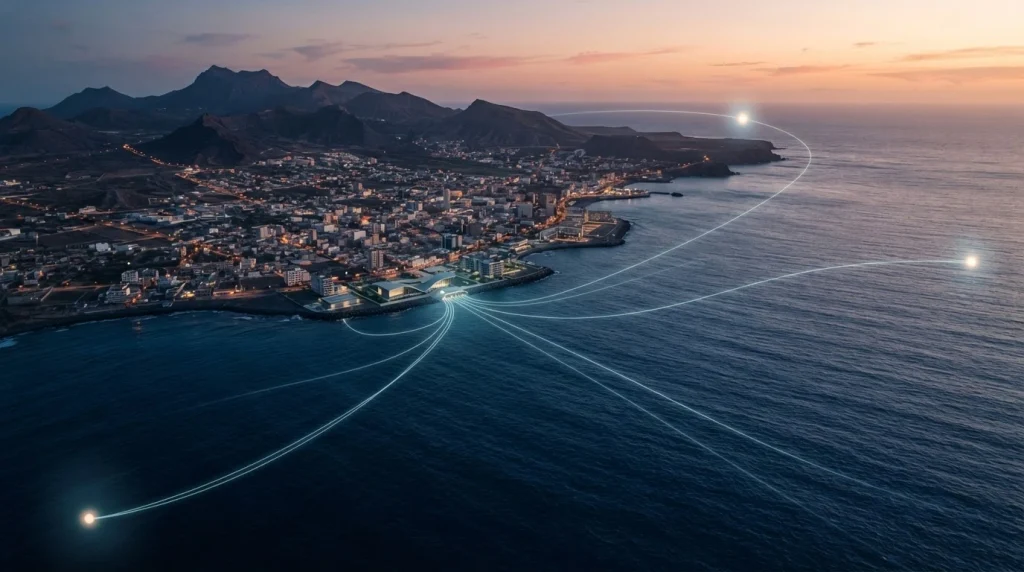
The global internet is often imagined as something that travels through satellites or the air. In practice, submarine fiber-optic cables carry the vast majority of international data traffic. These cables connect countries and continents, linking data centers, telecommunications networks and businesses. Their routes influence how quickly information travels, how much it costs to move, and how well networks can continue operating if a cable is disrupted.
For many years, international connectivity has been shaped by established corridors, including dense routes across the North Atlantic and links along the African coast. The South Atlantic has its own cable connections, but further route diversity could support a more balanced network between the continents bordering it.
A direct or more efficient connection between Europe, West Africa and Latin America would not simply be a matter of drawing a line across the ocean. Cable systems require extensive planning: operators assess seabed conditions, landing locations, permitting, financing, maintenance access and the expected demand from customers. They also need agreements with the countries where cables come ashore and with the companies that will connect those cables to local networks.
In this context, Cabo Verde’s value is not that it automatically offers the shortest route for every connection. It is that the archipelago could serve as a strategic node within a wider network: a place where international systems can land, exchange traffic, connect with regional markets and provide an alternative path if another route is unavailable.
An island nation with a regional outlook
Cabo Verde consists of ten main islands in the Atlantic, around 600 kilometres west of Senegal. Its position has long shaped its history, economy and relationships with the wider world. Today, that same location could support a new role in digital infrastructure.
A cable landing in Cabo Verde could connect international capacity to the country’s domestic telecommunications networks. With the right links between islands, it could also help make high-quality digital services more accessible across the archipelago. A regional hub could potentially support traffic between West Africa, Europe and Latin America, while creating opportunities in areas such as data hosting, network operations and digital services.
The most significant promise may lie in diversification. Networks are more robust when data can travel through multiple routes rather than relying on a limited number of links. An additional South Atlantic pathway could give operators and customers more options, improve resilience against outages, and create new commercial possibilities for businesses that serve more than one continent.
That benefit is not guaranteed. A cable route only becomes useful to customers when it is connected to affordable, high-capacity networks on land. If international capacity arrives but local infrastructure remains expensive or unreliable, the broader economy may see little change. Cable landing facilities, fiber links, data centers, power systems and skilled maintenance teams must work together.
From cable landing to digital gateway
The phrase “digital gateway” can sound like a finished destination. In reality, it describes a collection of capabilities that take years to build.
The first step is international connectivity: submarine cables and landing stations that allow data to enter and leave the country. The next is domestic infrastructure, including fiber networks and reliable links between islands. Then come the services that make connectivity valuable: data storage, cloud access, secure facilities, network exchanges and business services that can operate across borders.
A country can host a cable without becoming a major digital hub. To move beyond landing infrastructure, Cabo Verde would need to attract companies that see a clear reason to establish operations there. That could include telecommunications operators, cloud and data-center providers, network exchange operators, cybersecurity businesses and firms supporting digital trade.
Those companies will consider practical questions. Is electricity consistently available, and can it be supplied at a predictable cost? Are there suitable sites for secure facilities? Can businesses hire people with the necessary technical skills? Are licensing rules transparent? Can international companies move equipment and expertise efficiently? Are there strong data-protection and cybersecurity frameworks?
The answers will shape whether a cable landing becomes a local asset or simply a point on a map.
The investment challenge
Submarine cable projects involve significant capital and long planning timelines. Investors must forecast demand years ahead, coordinate with multiple governments and operators, and consider how a system will be maintained over its working life. They also have to assess whether the expected revenue justifies the cost and whether enough customers will use the capacity.
For Cabo Verde, attracting investment may require a mix of public and private sector planning. Government can help by providing predictable rules, coordinating permits and supporting infrastructure that benefits the wider economy. Private operators can bring technical expertise, capital and access to international markets. Regional partnerships can help ensure that the route serves more than a single national market.
The goal should not be simply to secure a cable announcement. It should be to build a sustainable digital ecosystem around connectivity. That means planning for the whole chain: landing sites, backhaul networks, power, maintenance, customer access and local expertise. It also means considering how the benefits will be shared among businesses, communities and public institutions.
A strong business case is essential. Operators will want evidence of demand—from telecom providers, cloud platforms, financial services, public agencies and other large users. Local and regional businesses, in turn, need affordable and dependable services to grow. Building that demand may require coordinated work on digital skills, online public services, entrepreneurship and cross-border commerce.
The power and climate question
Digital infrastructure depends on energy. Data centers and network facilities require reliable electricity, while cable landing stations and telecommunications equipment need power systems that can operate continuously. For an island economy, energy planning is therefore central to any ambition to attract large digital facilities.
Renewable energy could be part of the answer. Cabo Verde has substantial potential in wind and solar power, though expanding renewable generation, storage and grid capacity requires investment and careful planning. Companies considering data infrastructure increasingly pay attention to energy costs and environmental performance, making clean and dependable electricity a possible competitive advantage.
But renewable power must be available when facilities need it, not only when weather conditions are favorable. That means investment in storage, grid resilience, backup systems and efficient facility design. Digital growth should also be planned with water availability, land use and climate risks in mind. Island communities are particularly exposed to environmental pressures, and infrastructure must be designed to withstand them.
The opportunity is to make connectivity and sustainability part of the same strategy. If Cabo Verde can combine international links with reliable, lower-carbon energy and efficient operations, it may become more attractive to investors seeking resilient locations.
Building local value
A digital gateway should create value beyond the fees associated with landing cables. The most durable benefits would come from skills, jobs, businesses and services that remain in the country.
Technical education and training could prepare more Cabo Verdeans for work in network engineering, cybersecurity, data operations and digital business. Partnerships between education providers, public institutions and companies could help align training with industry needs. Local firms could also benefit from procurement opportunities, technical contracts and access to better international connectivity.
Improved networks could support sectors beyond technology. Tourism businesses may benefit from more reliable booking and payment systems. Financial services could offer safer digital transactions. Schools and universities could access more online resources. Public agencies could deliver services more efficiently, particularly to residents living across multiple islands. Entrepreneurs could reach customers beyond the domestic market.
These outcomes are possible, not automatic. Lower wholesale connectivity costs do not always translate into lower prices for households or small businesses. Regulators and policymakers may need to encourage competition, monitor service quality and ensure that remote communities are not left behind. The success of a digital strategy should be measured not only by the volume of international traffic, but also by whether people and businesses can use the network.
Regional cooperation is essential
Cabo Verde’s location gives it a potential role in regional connectivity, but it cannot build a South Atlantic network alone. Cable routes, internet exchanges and telecom services depend on cooperation among countries, operators and investors. West African markets, European partners and Latin American destinations all have a stake in the reliability and commercial viability of a new route.
Regional collaboration could help align technical standards, simplify cross-border arrangements and build a stronger case for investment. It could also support shared emergency planning for outages and maintenance. For companies, a route that connects multiple markets is often more compelling than infrastructure designed to serve just one destination.
Cabo Verde can contribute by presenting a clear, consistent offer: reliable regulation, a capable landing environment, skilled workers and a long-term commitment to open, secure connectivity. It can also help ensure that regional ambitions are grounded in practical needs—such as affordable bandwidth, dependable service and investment in local networks.
Turning possibility into strategy
The case for Cabo Verde as a digital gateway is ultimately a case for preparation. The country’s location creates an opening, but investors will look for more than a favorable position on the Atlantic. They will look for clear rules, reliable power, strong infrastructure, skilled people and evidence that customers are ready to use the network.
A thoughtful strategy would begin with a realistic assessment of demand and existing connectivity. It would identify the infrastructure gaps that matter most, establish transparent permitting processes and set expectations for environmental and community impact. It would also make space for competition and ensure that international investment strengthens local capacity.
If those pieces come together, Cabo Verde could become more than a landing point. It could serve as a resilient connection between continents, support the growth of regional digital services and give local businesses a stronger platform in the global economy.
That future is not inevitable, and it will not arrive with a single cable. It will be built through coordinated decisions—about routes, energy, regulation, education and access. The South Atlantic may offer Cabo Verde a rare opportunity to turn geography into influence. The challenge now is to make sure the digital infrastructure developed there is not only internationally connected, but locally valuable.
Cosmopolitan The Daily is a digital publication covering business, technology, culture and developments shaping connected communities. This article is an editorial feature examining Cabo Verde’s potential role in international digital infrastructure.