Southeast Asia is becoming the world’s most important coal-demand growth story. While coal use is flattening or falling across much of Europe and North America, and even as parts of East Asia begin to peak, several Southeast Asian economies are adding coal-fired generation at a pace that outstrips other regions. The reasons are not ideological—they are structural: fast-rising electricity demand, the need for dependable baseload power, domestic resource advantages in some markets, and the reality that grid stability and affordability remain the primary political and economic priorities.
This matters well beyond the region. Coal remains the most carbon-intensive major fuel, and Southeast Asia’s energy choices will influence global emissions trajectories, commodity markets, and the pace of investment in alternative generation and grid infrastructure. For policymakers and business leaders, the question is no longer whether Southeast Asia is growing—it is whether its energy systems can scale quickly enough with reliability and cost discipline while meeting climate and financing constraints.
Why demand is accelerating in Southeast Asia
Across Southeast Asia, electricity demand is rising quickly due to three overlapping forces.
First, industrialisation and manufacturing relocation are increasing power consumption. As global supply chains diversify, countries such as Vietnam and Indonesia are attracting energy-intensive manufacturing. Industrial parks, export processing zones, and new logistics hubs require stable power, not intermittent supply.
Second, urbanisation and a growing middle class are expanding household electricity use. Air conditioning penetration is rising, appliances are becoming more common, and commercial real estate is expanding. The region’s climate makes cooling demand a structural driver, and peak demand often coincides with hot seasons.
Third, digital infrastructure is scaling. Data centres, telecom networks, and the electrification of services add load that is continuous and reliability-sensitive. Even where the absolute share is still small, the growth rate is meaningful.
In this environment, coal has remained attractive because it can deliver large volumes of dispatchable electricity at a predictable cost—especially where domestic coal is available or where long-term import contracts can be secured.
Coal’s role: reliability, affordability, and grid stability
Coal’s central advantage in Southeast Asia is operational: it provides firm generation that can run day and night. Many grids in the region are still strengthening transmission capacity, expanding interconnections, and improving system flexibility. Until those upgrades are complete, coal offers a straightforward way to meet baseload demand.
Affordability is the second driver. In emerging markets, power tariffs are politically sensitive. Even small increases in electricity prices can affect household budgets and industrial competitiveness. Coal plants, once built, can provide relatively low-cost electricity, particularly when fuel supply is stable.
Grid stability is the third factor. Variable renewable energy—primarily solar and wind—requires balancing resources such as flexible gas generation, storage, demand response, and stronger transmission. These systems are being built, but not yet at the scale required to replace coal quickly in every market.
Country dynamics: different paths, similar pressures
Southeast Asia is not a single market. Coal demand growth is shaped by each country’s resource base, policy choices, and investment constraints.
Indonesia: domestic supply and export influence
Indonesia is both a major coal producer and a large domestic consumer. Its domestic market obligation policies and the availability of local coal have supported coal-fired generation expansion. At the same time, Indonesia’s export position influences regional pricing and supply security. When global coal markets tighten, import-dependent countries feel the impact quickly.
Vietnam: manufacturing growth and rapid load expansion
Vietnam’s electricity demand has grown sharply alongside its manufacturing and export sectors. Coal has played a significant role in meeting this demand, particularly as the system scales. However, Vietnam is also expanding renewables and considering grid upgrades and policy reforms to manage integration challenges.
Philippines: energy security and price volatility
The Philippines has faced energy price volatility and supply constraints. Coal has been used to support reliability, but import dependence creates exposure to global coal price swings. This is pushing a broader debate about diversification, including renewables, gas, and storage.
Malaysia and Thailand: balancing gas, coal, and transition goals
Malaysia and Thailand have historically relied more on gas, but coal remains part of the mix. The transition challenge is not simply replacing coal; it is ensuring that new capacity is financeable, reliable, and aligned with industrial demand growth.
The financing reality: coal is getting harder to fund
Even as demand grows, coal financing is tightening. Many international banks and institutional investors have restricted coal exposure. Multilateral development banks and export credit agencies increasingly apply stricter climate criteria. This creates a paradox: coal remains operationally attractive for reliability, but the cost of capital and reputational risk make new projects harder to justify.
As a result, the region is likely to see a split between:
- Existing coal fleets running longer to meet demand and maintain grid stability.
- Fewer new coal projects, with more scrutiny on emissions controls, efficiency, and transition plans.
- Hybrid transition strategies, where renewables expand rapidly but coal remains a stabilising backbone until flexibility resources scale.
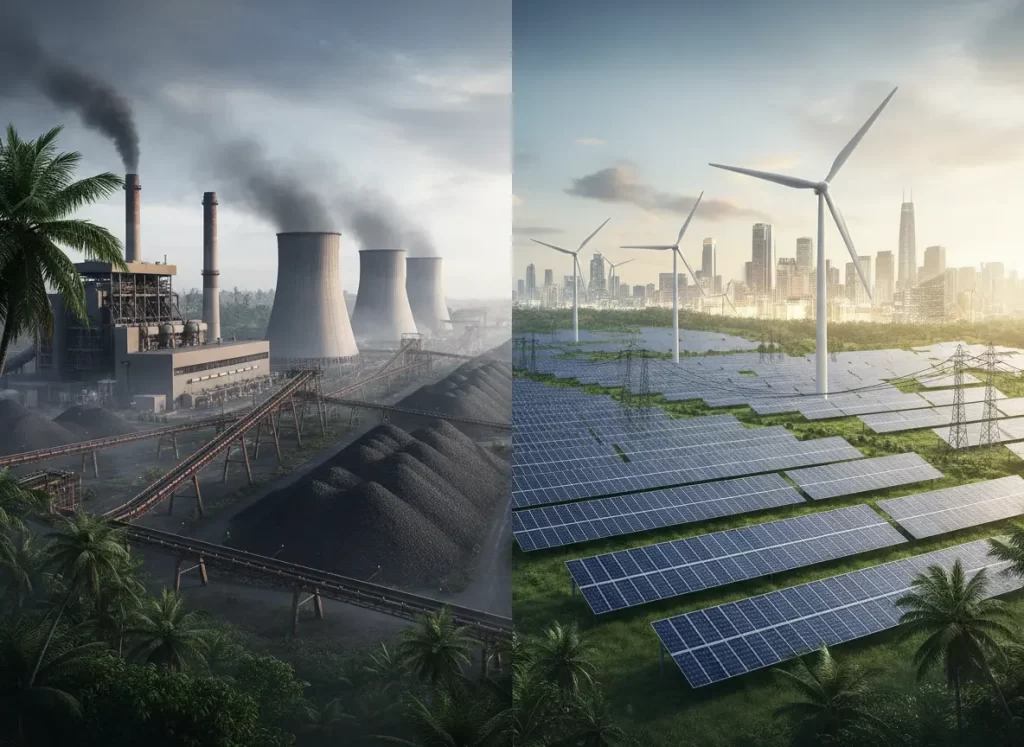
The transition bottlenecks: why renewables alone are not enough—yet
Southeast Asia has strong renewable potential, especially solar. Costs have fallen, and deployment is increasing. But three bottlenecks slow coal displacement.
1) Grid infrastructure
Transmission and distribution upgrades take time, planning capacity, and capital. Renewable projects can be built quickly, but connecting them and moving power to demand centres is often the limiting factor.
2) System flexibility
High renewable penetration requires balancing. Storage is improving, but large-scale deployment remains uneven. Gas can provide flexibility, but it introduces import dependence and price exposure unless domestic supply is available.
3) Policy and market design
Power markets in many countries are still evolving. Clear rules for procurement, pricing, curtailment, and grid access are essential to accelerate investment. Without stable policy frameworks, capital becomes cautious and projects slow.
What coal growth means for business leaders
For executives and investors, Southeast Asia’s coal demand growth is not only an energy story—it is a competitiveness story.
- Manufacturers must assess power reliability and tariff stability when choosing locations.
- Energy-intensive industries need long-term visibility on power costs and carbon policy.
- Commodity traders and logistics firms will see continued coal flows, but with higher volatility tied to policy shifts and financing constraints.
- Renewable developers and grid technology providers face a large opportunity, but must navigate permitting, interconnection, and regulatory complexity.
The strategic question is how quickly the region can build the enabling infrastructure—transmission, storage, flexible generation, and market reforms—to reduce coal reliance without sacrificing growth.
The policy dilemma: growth versus decarbonisation
Southeast Asian governments face a difficult balancing act. They must deliver affordable electricity to support jobs, industrial expansion, and social stability, while also responding to climate commitments and international pressure.
A pragmatic path is emerging in many markets:
- Accelerate renewables where grid conditions allow.
- Improve coal plant efficiency and emissions controls.
- Retire the oldest, least efficient units first where feasible.
- Invest heavily in grid upgrades and flexibility resources.
- Develop credible transition financing mechanisms that reduce the cost of capital for cleaner capacity.
This approach does not eliminate coal overnight, but it can bend the curve—reducing the growth rate of coal use and creating a pathway to peak demand.
Where the story goes next
Southeast Asia’s coal demand is growing faster than anywhere else because the region is growing faster than many parts of the world—and because reliable power remains the foundation of that growth. The next decade will be defined by whether the region can scale clean energy and grid flexibility quickly enough to meet rising demand without locking in high emissions.
For global markets, the region will remain a key driver of seaborne coal trade and price dynamics. For climate outcomes, Southeast Asia’s choices will be pivotal. For businesses, the opportunity lies in enabling the transition: building the infrastructure, financing models, and technologies that deliver reliability at lower carbon intensity.
Cosmopolitan The Daily is a global business news platform covering Finance, Technology, Energy, and Real Estate, with teams across major business hubs including Bangalore, London, New York, Toronto, Dubai, Kuala Lumpur, and Sydney. We deliver fact-driven reporting and market intelligence for directors and executives, combining daily coverage with industry visibility initiatives such as our annual Business Excellence Awards.
If you are tracking energy markets, infrastructure investment, or the policy shifts shaping the next phase of growth in Southeast Asia, Cosmopolitan The Daily will continue to provide clear, sector-specific insights from across the region and beyond.