Europe’s electricity grids are being asked to do things their designers never imagined. Rooftop solar, heat pumps, electric vehicles, batteries and wind farms are rewriting the rules of when and where power is produced and consumed. Behind the scenes, the people responsible for keeping the lights on are juggling market rules, regulatory deadlines and the unforgiving physics of stable voltage and frequency, often all at once.
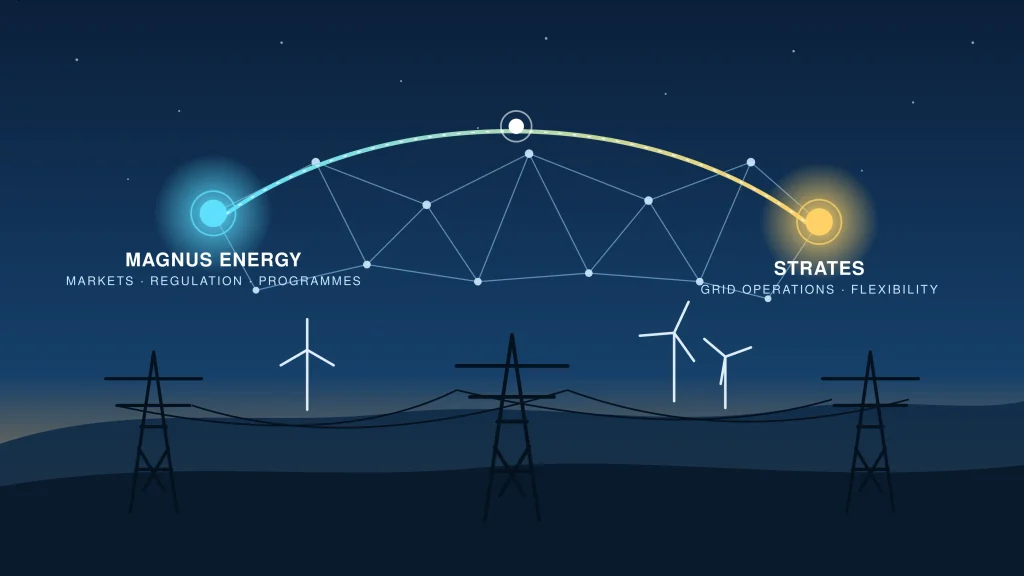
Against that backdrop, Dutch energy consultancy Magnus Energy announced that it has entered into a partnership with Strates, an independent, Swiss-founded consultancy focused on electricity grid operations. The pairing joins a firm known for energy markets, regulation and complex multi-country programmes with one rooted in the daily realities of running networks. The stated ambition is to help transmission system operators (TSOs), distribution system operators (DSOs), flexibility providers and other energy market participants arrive at solutions that are strategically sound and that also work when deployed on the real grid.
It is a modest-sounding announcement with a pointed message: in the European energy transition, the distance between a good idea and a working system is where many projects succeed or fail.
Where markets, regulation and the control room meet
For years, advisers to Europe’s energy sector have tended to specialise. Some concentrate on market design and regulation: how electricity is traded, how cross-border capacity is allocated, how European network codes are put into practice. Others come from the operational side, the control rooms, planning departments and field teams where theory meets the stubborn behaviour of physical equipment. The Magnus Energy and Strates partnership is a bet that the line between those two worlds has become too thin to justify keeping them apart.
Alexander van der Mark, Managing Director of Magnus Energy, framed the logic in exactly those terms. A growing share of the questions clients bring to his firm, he explained, sits at the intersection of markets, regulation and physical grid operations, and Strates supplies the operational perspective those questions demand. He also offered a simple test for any new grid concept: an idea can look flawless on a presentation slide and still struggle in the control room. Getting it right, he suggested, means weighing market and regulatory design together with the operator’s point of view from day one, rather than bolting one onto the other after the fact.
Stéphane Dätwyler Duarte, the founder of Strates, shares that reading of the moment. In his view, the energy transition is putting grids, markets and regulation under pressure simultaneously. That, he argued, means grid operators and market parties need partners who can connect the strategic picture with what actually happens in the control room.
Magnus Energy: market expertise at European scale
Magnus Energy is headquartered in the Netherlands and specialises in the energy sector, delivering projects across Europe. The firm now counts more than 110 consultants and experts and operates hubs in Brussels, Cologne, Copenhagen and Vienna, giving it a physical presence close to the institutions, system operators and market platforms that shape the continent’s power system. Its work covers the energy value chain, but its deepest strengths lie in power and electricity markets.
That reputation was built largely on large, multi-year, multi-party programmes. Since 2016, the firm has been the lead consulting company on two strategic programmes in Europe’s electricity market design, the Core CCR and Core Joint initiatives, which bring together grid operators across a wide swathe of Central West and Eastern Europe to implement European electricity network codes. It has also supported the roll-out of the pan-European MARI platform, the centralised system for exchanging manual balancing energy across borders, and has contributed test management and implementation support on major interconnectors, including ALEGrO between Belgium and Germany and NordLink between Germany and Norway.
In recent years the company has expanded steadily. It opened a Brussels office in early 2025 and announced Nordic ambitions the same year. In 2024 it combined with Dutch consultancy Ciratum, creating a business of roughly 100 people. In September 2025 it signed a strategic partnership with Hungary-based gridDigIt to serve TSOs on the practical implementation of common grid model exchange standards. In January 2026 it promoted three directors from within, and in late 2025 it brought in Walter de Leeuw to broaden its advisory offering to TSOs, DSOs and European electricity bodies. The Strates partnership fits a clear pattern: Magnus Energy is steadily assembling the capabilities its clients ask for, through hiring, combination and collaboration.
Strates: an operator’s experience and an independent voice
Strates is a younger and smaller outfit, and that is part of its appeal. It was founded in Switzerland by Stéphane Dätwyler Duarte, whose career has been spent inside the electricity system rather than alongside it. He has worked on system operations and intraday congestion forecasting at Swissgrid, Switzerland’s national transmission system operator. He has handled congestion management and market concepts at 50Hertz, one of Germany’s four transmission operators. And he has held roles in grid operations and strategy at Romande Energie, a regional energy company, which gives him a view from the distribution side of the network as well.
That trajectory, from national transmission, to a major German TSO, to a regional utility, is unusual and valuable. It spans the layers of the grid that are increasingly being asked to coordinate. Duarte’s areas of expertise include grid observability, meaning how well operators can actually see what is happening on their networks, along with grid connections, dynamic grid tariffs and the coordination between TSOs and DSOs.
Each of those topics has moved from the margins to the centre of European energy debates. Observability becomes harder as generation spreads across thousands of small sources. Grid connections are a bottleneck for new renewables, storage and industrial demand. Dynamic tariffs promise to nudge consumption towards moments when the grid has room. And TSO-DSO coordination determines whether flexibility offered at the local level can be used safely at the national one. Strates sits squarely on top of these questions.
Why the timing matters
The partnership arrives as the European energy transition reshapes how electricity grids are planned, managed and run. Growing electrification is lifting demand in transport, heating and industry. The rapid expansion of distributed generation is moving production from a handful of large power stations to a vast number of smaller installations, many of them connected at distribution level. And flexibility, the ability of consumers, batteries and other assets to shift or adjust their power use or output, is taking on an increasingly important role in balancing the system.
These shifts create particular strain at the interface between transmission and distribution networks. A decision made by a DSO about a local congestion problem can affect the TSO’s ability to manage the wider system, and vice versa. Flexibility that is valuable to one party may be unusable, or even harmful, to another if the two are not coordinated. At the same time, market designs and regulatory frameworks are evolving, placing greater demands on coordination across the electricity system and leaving less room for operators to improvise.
For energy companies and grid operators, the practical implication is that strategy, market design and operations can no longer be treated as separate workstreams handled by separate teams, or separate advisers. A flexibility product that looks attractive on paper must be observable, dispatchable and compatible with the way control rooms actually work. A new connection policy must reflect both regulatory obligations and what the network can physically bear. Bridging that gap, between planning and reality, is the problem the two firms say they intend to address.
Complementary strengths
Both companies were explicit that the partnership is built on complementary capabilities rather than overlap. Magnus Energy brings deep knowledge of energy markets and regulation, experience running complex international programmes, and an extensive network of TSOs, DSOs and other market participants across Europe. Strates contributes hands-on experience in congestion management, flexibility, observability and TSO-DSO coordination.
To see why that combination could matter, consider an illustrative scenario rather than a specific project. Imagine a distribution operator that wants to buy flexibility from local batteries and industrial users to relieve congestion in a fast-growing area. Doing so requires a market mechanism that is compatible with European rules, a regulatory case that stands up to scrutiny, a data and observability set-up that lets the operator verify the service was delivered, and a way of coordinating with the transmission operator so that the local fix does not create a problem upstream. Historically, those pieces might have been advised on by different parties, each looking at only a slice. A joint team can, in principle, design them as one coherent system.
Duarte described the aim in similar terms: helping clients move from strategy to solutions that work in daily operation, and making the most of flexibility to support an energy system that is secure, affordable and sustainable. That triad, security, affordability and sustainability, is the political and technical balance European policymakers keep returning to, and it is rarely achieved by any one of the three alone.
Who stands to benefit
The partnership is aimed at a broad group. Transmission operators are the most obvious beneficiaries, particularly those already engaged in cross-border programmes where Magnus Energy has long experience and where operational realities must be reflected in jointly agreed market rules. Distribution operators, for whom the energy transition has been especially disruptive, may find value in advice that treats their local challenges, from connection queues to congestion, as part of the wider system rather than as isolated problems.
Flexibility providers are another named audience. Aggregators, battery operators and industrial consumers who want to monetise their ability to adjust demand or output often struggle to navigate the rules and technical requirements that determine whether their services are accepted. Advisers who understand both the market framework and the operational prerequisites can shorten that journey. The announcement also refers more generally to other energy market participants, a category that could include market operators, regulators, utilities and developers.
For Strates, the partnership offers reach. An independent specialist can bring sharp expertise, but it can be difficult to participate in large, multi-party European programmes without an established platform. By joining forces with a firm with more than 110 people, hubs in four countries and long-standing relationships across the sector, Strates gains a route into the kind of work its founder’s expertise is suited for. For Magnus Energy, the gain is depth where its clients increasingly need it, without having to build an operations practice from scratch.
Part of a wider pattern in energy consulting
The announcement also reflects how the advisory industry itself is adapting. As energy systems become more complex, clients tend to want integrated answers, yet the knowledge required is too specialised for any single firm to hold in full. The result is a growing number of partnerships, alliances and combinations in which specialists bring distinct strengths to shared projects.
Magnus Energy has been an active participant in that trend, with its Ciratum combination, its gridDigIt alliance and now its Strates partnership. Each addresses a different piece of the puzzle: broadening consulting capacity, bringing in technical expertise on grid model exchange, and adding operational insight into congestion, flexibility and observability. Taken together, they point to a strategy of building a network of capabilities around a core of market and regulatory expertise, an approach designed to keep pace with a sector whose problems rarely respect disciplinary boundaries.
For clients, the appeal of partnerships over acquisitions can be practical. They allow firms to retain the independence and specialism that make small consultancies valuable while still offering a single point of contact and a shared methodology. Whether that model scales, and how clients experience it in practice, will depend on execution: clear scoping, consistent quality and the discipline to say when a project calls for a different kind of expertise.
What to watch next
The announcement sets out the purpose and the logic of the partnership, but leaves several practical questions open. It does not detail specific joint services, named client engagements or the commercial arrangements between the two firms. Those will become clearer as the collaboration takes shape and as the first projects are announced.
Several themes are worth watching. One is how the partners approach TSO-DSO coordination, an area where European regulators, operators and market parties are all seeking workable models. Another is flexibility: how it is defined, procured and verified is likely to determine whether the promise of a more responsive demand side is realised. A third is observability, where better data and monitoring are becoming prerequisites for almost every other innovation in grid operations. If the partnership can offer practical, tested guidance in even one of these areas, it will have earned its place.
The broader point is hard to dispute. Europe’s electricity system is being rebuilt while it is running, and the people responsible for it need advice that respects both the ambition of the policy and the constraints of the equipment. By pairing market and regulatory depth with operational insight, Magnus Energy and Strates are betting that the most useful consultants in the years ahead will be those who can speak both languages fluently, and who can show that a concept that works on the slide also works on the grid.
Magnus Energy is a consultancy headquartered in the Netherlands and dedicated to the energy sector, delivering projects across Europe. Founded in 2008, the firm has grown to more than 110 consultants and experts, representing 17 nationalities, with hubs in Brussels, Cologne, Copenhagen and Vienna. Its work spans the energy value chain, with particular strengths in power and electricity markets. Magnus Energy supports transmission system operators, distribution system operators, power exchanges and European electricity bodies in implementing new regulations, integrating renewables and delivering complex, multi-year programmes that help make the grid ready for the energy transition. Alexander van der Mark serves as Managing Director.
Strates is an independent consultancy focused on electricity grid operations, founded in Switzerland by Stéphane Dätwyler Duarte. Drawing on experience in system operations and intraday congestion forecasting at Swissgrid, congestion management and market concepts at 50Hertz, and grid operations and strategy at Romande Energie, Strates advises on grid observability, grid connections, dynamic grid tariffs, congestion management, flexibility and coordination between transmission and distribution system operators.
Cosmopolitan The Daily is a digital publication delivering a daily mix of news, business stories for a curious, globally minded audience. Its editorial team covers the people, companies and ideas shaping how we work, live and connect, from industry partnerships and innovation to the trends changing everyday life.