Stablecoins have been described as the future of cross-border money while remaining awkward to use in practice. Dollar-pegged tokens move across blockchains in seconds. A business that wants to pay a supplier in another country with them still has to find a regulated way to create the tokens, convert them back into cash, and settle with a counterparty who is willing to accept them. That last stretch, between the blockchain and the real economy, is where most of the friction sits.
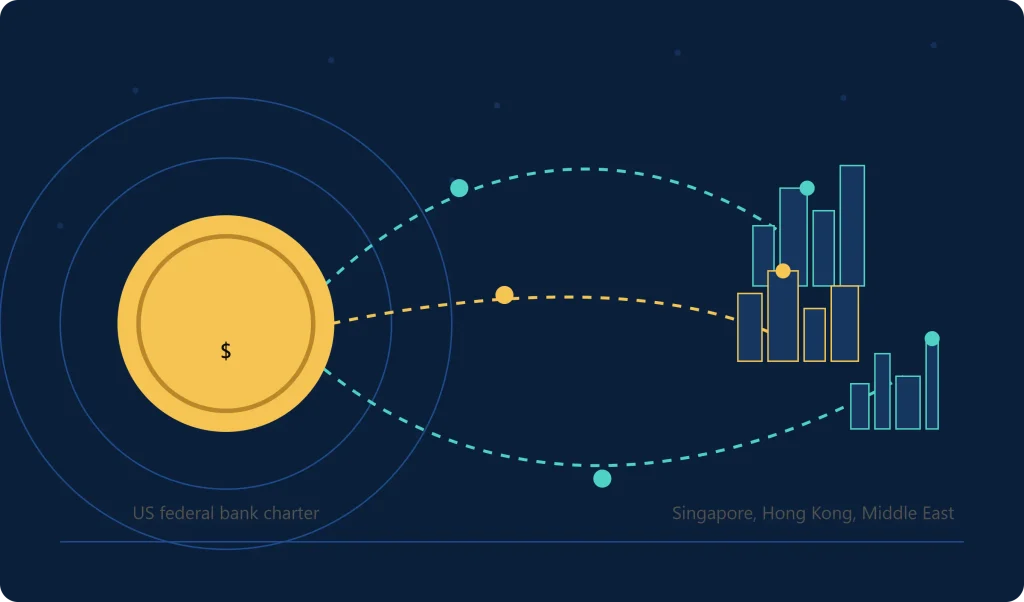
A partnership announced this week targets exactly that gap. Singapore-headquartered payment institution FOMO Pay announced on November 18 that it is partnering with Anchorage Digital, home to the first federally chartered digital asset bank in the United States. The two companies describe it as a step toward connecting US stablecoin infrastructure with regulated payment and settlement use cases across Asia and the Middle East.
What the partnership actually does
The mechanics are straightforward. FOMO Pay says it is the first payment institution in Singapore to integrate with Anchorage Digital’s US platform. Through that integration, it will plug in Anchorage Digital Bank’s stablecoin issuance, redemption and banking services, along with over-the-counter services, so that merchants, platforms and institutional clients can use a wider range of stablecoin products for cross-border transfers and commercial settlement.
FOMO Pay will use Anchorage Digital Bank’s infrastructure for stablecoin minting and redemption and will separately access Anchorage Digital’s trading services. In plain terms, that means a regulated route in and out of dollar tokens. A client can convert funds into a US-regulated stablecoin, move it where it needs to go, and redeem it at the other end.
The arrangement also runs in the other direction. The collaboration is meant to give Anchorage Digital a way to extend its reach through FOMO Pay’s established payment network. Anchorage supplies the regulated issuance and banking layer. FOMO Pay supplies the local licenses, merchant relationships and settlement channels that make the tokens useful in the markets where its clients operate.
There is also a second phase. In a later stage, the collaboration is expected to extend to digital asset custody solutions for FOMO Pay through Anchorage Digital, subject to applicable technical, regulatory and compliance requirements. Custody would let FOMO Pay hold digital assets through a regulated US bank rather than relying only on outside wallet arrangements.
Why a US charter matters to Asian and Middle Eastern payments
The partnership leans heavily on regulatory credentials. Anchorage Digital Bank operates under a national trust bank charter from the US Office of the Comptroller of the Currency. That sets it apart in a market where many stablecoin issuers are non-bank entities or operate under state-level regimes.
Anchorage has moved steadily to turn that status into a product line. It launched its stablecoin issuance platform in July 2025, immediately after the passage of the GENIUS Act in the United States. Since then it has collected a string of issuance and infrastructure relationships. In December 2025 it was named the US regulated issuer for USDGO, a dollar-backed stablecoin branded by OSL Group, which describes itself as Asia’s leading stablecoin trading and payment platform. In February 2026 it introduced a “Stablecoin Solutions for Banks” service, giving licensed US federal banks stablecoin payment rails for outbound and inbound US dollar transfers. It has also acquired the payments company Routable to extend its rails to large corporate clients that need both fiat and digital asset capability.
The FOMO Pay deal fits that pattern. Anchorage is building an issuance and settlement backbone, and it needs distribution partners that already hold licences and customers in the regions where demand for dollar liquidity is highest. Asia and the Middle East are two of the most active corridors for trade, remittances and corporate treasury flows, and both have regulators that have become more structured in how they treat digital assets.
Anchorage already has a presence in Singapore. The company has a Singapore entity licensed by the Monetary Authority of Singapore. Pairing that local standing with a Singapore-based payment partner makes the corridor easier to explain to compliance teams and regulators on both sides.
FOMO Pay’s expanding stablecoin playbook
For FOMO Pay, the Anchorage relationship is the latest in a series of moves into digital-asset payments. The company is a major payment institution licensed in Singapore, Hong Kong and the Middle East. Over the past two years it has been assembling partnerships that combine traditional banking rails with newer settlement technology.
In May 2025, FOMO Pay was invited to join the Global Dollar Network as one of its first partners, planning to integrate the Paxos-issued Global Dollar (USDG) into its payment infrastructure so merchants could accept it and corporates could use it for cross-border payments. Industry coverage has also recorded a collaboration with BNY to enhance USD payment services for corporate clients, and a partnership with the UAE digital bank Zand to improve cross-border payment efficiency between Asia and the Middle East and North Africa. A related announcement on its website describes a collaboration with BNY to enable 24/7 USD settlement.
Taken together, these deals show a company positioning itself as a connector. It does not want to be a stablecoin issuer or a bank. It wants to be the licensed layer that lets corporates and merchants in its markets use whichever dollar instrument and banking partner best suits a given payment. Anchorage adds a US-chartered issuer and trading counterparty to that menu.
A problem that has been waiting for a solution
The case for stablecoin-based settlement rests on a familiar set of complaints. Traditional cross-border payments often pass through chains of correspondent banks, each adding cost, time and opacity. Business hours and time zones matter, because a payment initiated in Singapore on a Friday afternoon can sit idle over a weekend before it reaches a counterparty in another region. For small and mid-sized exporters, and for platforms paying out to a global workforce, the delay and the fees are a constant drag.
Dollar-denominated stablecoins promise to compress that process. They settle around the clock, and in principle they can be sent and received without the intermediary chain. The weakness has been trust and plumbing. A corporate treasurer will not route working capital through a token unless the issuer is credible, the reserves are protected, and there is a regulated way to turn the token back into money.
That is the part Anchorage is trying to answer with a federal bank charter, and the part FOMO Pay can reinforce with local licenses. As one industry briefing put it, the two firms’ regulatory footprints and geographic networks complement each other: Anchorage operates regulated US digital-asset infrastructure, while FOMO Pay has licensed payment rails across Asia and the Middle East.
Where the partnership is deliberately modest
The companies have been careful about scope, and that restraint is worth noting. The announcement frames the arrangement as infrastructure for regulated USD stablecoin use by clients in FOMO Pay’s markets. One analysis noted that this makes the partnership more focused than a broad claim of borderless stablecoin payments.
Several questions remain open. The custody phase is explicitly conditional on technical and regulatory requirements, so it should not be treated as imminent. The partnership also does not change local rules on who may accept stablecoins, how they are taxed, or how they are reported. Each of FOMO Pay’s licensing jurisdictions has its own expectations, and a payment that is permissible in one market may need additional controls in another.
Commentators have also pointed to the usual stress scenarios. One daily fintech brief observed that arrangements like this work smoothly when tokens trade at par and banking channels are open and argued that the partners need equally clear boundaries for the moments when they do not. That is a fair test for any stablecoin payment system. The real measure will be how redemption, liquidity and customer communication hold up if markets are disrupted, not how the product performs in calm conditions.
What it means for businesses
For companies in the corridor, the practical effect depends on how quickly the integration reaches customers. Merchants and platforms that already work with FOMO Pay may gain the option to settle in a US-regulated dollar token, rather than negotiating a separate arrangement with a crypto-native provider. Corporate clients that have been curious about stablecoin settlement but wary of counterparty risk may find the combination of a US federal bank and a locally licensed payment institution easier to approve internally.
Several categories of user are likely to be watching closely:
- Exporters and importers that pay suppliers or receive funds across Asia and the Middle East and want faster, more predictable settlement in US dollars.
- Digital platforms and marketplaces that pay out to freelancers, sellers or partners in multiple countries and need a cost-effective way to move dollars.
- Treasury teams looking for out-of-hours liquidity movements between regional entities without relying entirely on correspondent banking.
- Financial institutions exploring stablecoin rails as an adjunct to existing payment services.
For Anchorage, the benefit is distribution. Its banking-grade infrastructure is only valuable if it is used, and a payments network that touches merchants and corporates in several licensing regimes is a ready channel.
The bigger picture
The announcement lands in a market that is moving from experiment to infrastructure. Regulators in the United States, Singapore, Hong Kong and the Gulf have each been building frameworks that treat stablecoins as a regulated financial product, not a loophole. Banks, payment processors and remittance companies are testing token-based settlement alongside their existing systems, and large incumbents have started partnering with regulated issuers rather than building everything themselves.
Partnerships like this one suggest that the winning model may be collaborative. A US-chartered issuer, a regional payment institution with licences and merchants, and local banking partners each cover a piece of the chain that no single firm owns. Whether the model scales will depend on adoption by real businesses and on how it performs under stress. But the direction of travel is clear: regulated dollar tokens are being wired into the commercial payment networks of Asia and the Middle East, one licensed partnership at a time.
The first test will come in the months ahead, as clients begin to use the integrated services and as the companies decide whether and when to move to the custody phase. If that goes well, expect more payment institutions in the region to seek similar connections to US issuance infrastructure.
Anchorage Digital is a global crypto platform that enables institutions to participate in digital assets through trading, staking, custody, governance, settlement, stablecoin issuance, and security infrastructure. Its banking arm, Anchorage Digital Bank, N.A., is the first federally chartered digital asset bank in the United States and operates under a national trust bank charter from the Office of the Comptroller of the Currency.
Founded in 2015, FOMO Pay is a payment institution licensed in Singapore, Hong Kong and the Middle East, and describes itself as a one-stop digital payment, digital banking and digital asset solution provider. Its offerings include FOMO Payment for merchants, corporates and financial institutions, FOMO iBiz for business banking needs, and FOMO Treasury for corporate cash management and liquidity optimization. More information is available at fomopay.com.
Cosmopolitan The Daily is a leading digital media platform dedicated to delivering timely, insightful, and comprehensive news coverage across Africa. With a focus on business, economy, and technology, Cosmopolitan The Daily connects readers with quality journalism that informs and empowers. The publication is committed to highlighting stories of innovation and growth shaping the continent’s future.