For a gamer in São Paulo, Bogotá or Mexico City, buying a game key, a gift card or a mobile top-up should be as simple as tapping a phone. For years, it often was not. Credit cards, the default checkout tool in much of the world, are far from universal in Latin America, and online merchants that insisted on them quietly shut out a large share of eager customers. That gap is exactly what a partnership between two fast-moving companies, EBANX and Eneba, has been working to close. Now the collaboration has grown to cover eight Latin American countries, and the numbers suggest the approach is paying off.
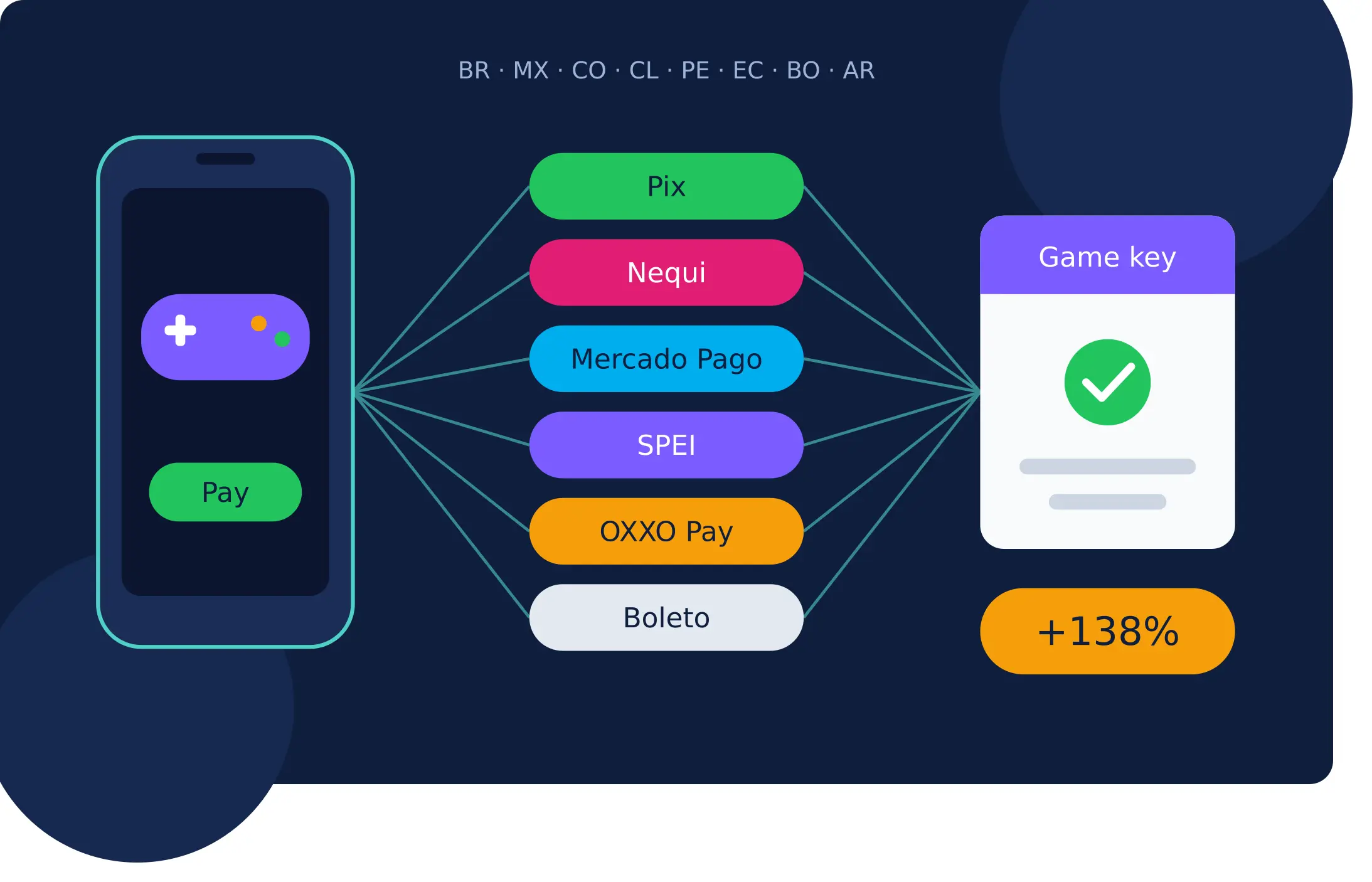
EBANX, a global technology company specialising in payment services for emerging markets, and Eneba, a global digital marketplace for video games, announced that their relationship has been strengthened and expanded across the region. According to the companies, Eneba’s payment volume processed through EBANX in Latin America grew 138 percent year over year through October 2026, compared with the same period in 2025. In other words, volume more than doubled in a single year.
A partnership that began with seven markets
The two companies first joined forces in 2023. At the outset, the collaboration spanned seven countries: Brazil, Mexico, Colombia, Chile, Peru, Ecuador and Bolivia. A year later, Argentina was added, bringing the total to the eight markets now covered. Together, those countries represent a broad cross-section of Latin America’s digital economy, from its largest consumer markets to smaller but fast-growing ones.
What ties the arrangement together is a simple idea: meet customers where they already are. Instead of asking every shopper to adapt to a single, global way of paying, Eneba has built a payment portfolio that combines traditional credit and debit cards with alternative payment methods, often shortened to APMs. These include digital wallets such as Mercado Pago and Colombia’s Nequi, instant payment systems such as Pix in Brazil and SPEI in Mexico, and cash-based options such as Brazil’s Boleto Bancário, Mexico’s OXXO Pay and Peru’s PagoEfectivo.
For the uninitiated, that list may read like alphabet soup. For millions of consumers in the region, however, each name represents an everyday habit. Pix lets people move money instantly between accounts, around the clock. Nequi is a familiar mobile wallet in Colombia. OXXO Pay and PagoEfectivo allow shoppers to place an order online and then settle it in cash at a physical location. Offering all of these side by side, rather than forcing a one-size-fits-all checkout, is the heart of the strategy.
The numbers behind the headline
The 138 percent growth figure is the most striking data point in the announcement, but it is not the only one worth noting. Throughout 2026, Eneba reported consistent growth in transaction volumes across key local payment methods, with Pix in Brazil, Nequi in Colombia and SPEI in Mexico singled out. The companies also describe Pix, Nequi and Mercado Pago as being among the most used payment methods by Eneba’s customers in the region.
That detail matters because it shows where the growth is coming from. It is not simply that more people are shopping online, although that is certainly part of the picture. It is that shoppers are choosing the payment methods that feel most natural to them, and that a merchant able to support those methods can convert more visitors into buyers.
The broader context supports that reading. Citing World Bank data, the companies noted that only about 25 percent of adults in Latin America own a credit card, while 51 percent have already made a digital payment. The contrast is telling. A large majority of adults in the region do not hold a credit card, yet a majority have already shown they are comfortable paying digitally. For a global merchant, that means the potential customer base is much bigger than card ownership alone would suggest, provided the checkout speaks the local language of payments.
Why local payments have become a growth engine
The story of Latin American e-commerce over the past several years has in many ways been a story of payments. Historically, international sellers that tried to enter the region often found that conversion rates lagged behind expectations. Card penetration was limited, cross-border card transactions were sometimes declined by issuers, and many consumers preferred to avoid sharing card details online. Local methods emerged to fill the void, and several of them have since become mainstream.
Brazil’s Pix, introduced by the country’s central bank, is perhaps the most visible example. Its speed, low friction and near-universal adoption have made it a staple of both in-person and online commerce. Mexico’s SPEI offers real-time bank transfers, while cash-based vouchers continue to serve shoppers who are unbanked, underbanked or simply prefer not to use cards. Each of these systems has its own rules, user experience and technical requirements, which is precisely why global merchants often need a specialist partner to support them.
James Booth, VP Commercial at EBANX, captured the challenge in plain terms. In his view, there is no single payment playbook for Latin America, and global merchants that want to scale across the region must understand the differences between markets and adapt their checkout to how consumers already pay. It is a message that resonates well beyond gaming: a strategy that works in one country can fall flat in the next if it ignores local habits.
What Eneba says about the collaboration
On the marketplace side, Mantas Eitutis, Head of Payments and Fraud at Eneba, described EBANX as a strong partner in supporting the company’s growth across Latin America. He pointed to the partner’s consistent performance and its extensive coverage of local payment methods as key factors that have helped Eneba reflect consumer preferences in each market.
The mention of fraud in Eitutis’s title is not incidental. Digital goods such as game keys and gift cards are attractive targets for bad actors, which means that merchants in this category must balance a frictionless checkout with robust fraud prevention. Eneba has said it backs its marketplace with strong customer support and fraud prevention measures, and reliable payment infrastructure is a critical part of that equation. When a payment partner can approve legitimate customers quickly while keeping risk under control, the entire business benefits.
Gaming, a natural fit for local payments
Video games are an especially good match for the local-payments model. The products are digital, delivery is instant and the buyers tend to be young, mobile-first and comfortable with new ways of paying. A teenager who wants a gift card for a favourite game may not have a credit card at all, but may well have access to a wallet app or a bank account linked to an instant-payment system. Cash-based options can also reach shoppers who are not yet fully integrated into the formal banking system.
For a marketplace like Eneba, which offers game keys, gift cards and mobile top-ups at competitive prices, removing payment friction is a direct route to growth. Every abandoned cart caused by an unsupported payment method is a lost sale, and every additional local option can recover some of that lost revenue. The 138 percent increase in processed volume suggests that expanding payment choice, market by market, can have a compounding effect.
It also reflects a wider shift in how digital entertainment is purchased in the region. As smartphone use grows and instant payment rails mature, shoppers increasingly expect to complete a purchase in seconds, using the same tools they use to split a restaurant bill or pay a friend. Merchants that meet that expectation earn loyalty, and those that do not risk losing customers to competitors that do.
What expansion across eight countries means
Operating across eight countries is no small feat. Each market has its own currency, regulatory environment, banking landscape and consumer preferences. A payment method that dominates in one country may be almost unknown in the next. Brazil’s Boleto Bancário, for instance, has no direct equivalent in Chile, and the popularity of a given wallet can vary widely from one border to another.
By working with a single partner that already connects to many of these local systems, Eneba can avoid the heavy lift of integrating each one separately. EBANX, for its part, builds the technology and infrastructure to link global merchants with those methods, enabling companies to offer hundreds of local payment options across Latin America, Africa and Asia. For the merchant, the benefit is speed and simplicity. For the shopper, it is a checkout that feels familiar.
The timeline of the partnership also illustrates a patient, step-by-step approach. Starting with seven countries in 2023, adding Argentina in 2024 and then deepening the relationship in 2026, the companies have grown their footprint gradually, learning from each market along the way. The 2026 figures indicate that this measured expansion has translated into real momentum.
The bigger picture for Latin America’s digital economy
The EBANX and Eneba story is a small window into a much larger transformation. Across Latin America, digital payments are moving from a convenience to a core part of daily life. Governments and central banks have promoted instant payment systems, fintech companies have broadened access to financial services, and consumers have embraced mobile wallets and online shopping at a rapid pace.
For global businesses, the lesson is increasingly clear. Success in the region depends less on simply translating a website and more on rebuilding the payment experience from the ground up. That means supporting the methods people trust, presenting prices in local currency, and ensuring that transactions are approved reliably. Companies that invest in this localisation tend to be rewarded with higher conversion and stronger customer relationships.
It also means recognising that the region is not a monolith. Brazil, with its enormous population and the dominance of Pix, behaves very differently from Mexico, where cards and cash-based methods coexist, or Colombia, where wallets such as Nequi have carved out a prominent role. Even smaller markets such as Ecuador and Bolivia bring their own dynamics. A partner with deep market expertise can help a merchant navigate these differences without reinventing the wheel in every country.
Looking ahead
Neither company has publicly outlined a detailed roadmap beyond the current eight countries, but the direction of travel is easy to read. With payment volume more than doubling in a year and digital payments continuing to expand across the region, there is clear room for further growth. Additional payment methods, deeper integrations and continued refinement of the checkout experience are all natural next steps for a partnership that has already proved it can scale.
For gamers across Latin America, the practical result is straightforward: more ways to pay, fewer barriers at checkout and faster access to the games and digital goods they want. For the companies involved, it is validation of a simple principle that is shaping the future of regional e-commerce. When merchants build around how people actually pay, the customers follow.
As Latin America’s digital economy continues to evolve, partnerships like this one are likely to become more common, and the benchmark for success will be set by those that listen closely to local consumers. By that measure, EBANX and Eneba have made a strong case that understanding the local market is not a luxury but a growth strategy.
EBANX is a payments platform that connects global businesses to the world’s fastest-growing digital markets. Founded in 2012 in Brazil, EBANX was built with a mission to expand access to international digital commerce. Beyond processing payments, the company aims to drive growth, enhance sales and deliver seamless purchase experiences for businesses and end users alike. Using proprietary technology, deep market expertise and robust infrastructure, EBANX enables global companies to offer hundreds of local payment methods across Latin America, Africa and Asia.
Eneba is a digital marketplace for video games that has served more than 15 million buyers. Founded in 2018, Eneba has grown into a trusted ecosystem for gamers, offering game keys, gift cards and mobile top-ups at competitive prices, backed by customer support and fraud prevention measures.
Cosmopolitan The Daily is a digital news that brings readers the stories shaping modern life. Drawing on the spirit of the Cosmopolitan name, which stands for curiosity, diversity and a global outlook, the publication covers business, technology, real estate, finance, banking, insurance, etc. for an audience that wants to stay informed and inspired. Updated throughout the day, Cosmopolitan The Daily delivers timely reporting, clear analysis and engaging features, connecting readers with the people, ideas and innovations that matter to them.