A landmark agreement signed on June 9, 2026 in Riyadh has set in motion one of the most ambitious overland connectivity projects in the modern history of the Middle East — a rail and logistics corridor stretching from the heartland of Saudi Arabia northward through Jordan, Syria, and onward to Turkey, ultimately linking the Arabian Peninsula with Istanbul and the gateway to Europe.
The memorandums of understanding, sealed between Turkey’s Ministry of Transport and Infrastructure and Saudi Arabia’s Ministry of Transport and Logistics Services, as well as a parallel agreement between the two countries’ national railway operators, represent a decisive shift in how both nations — and the broader region — conceptualize the movement of goods and people. In a world increasingly shaped by supply chain disruptions and geopolitical realignments, the corridor offers a land-based alternative to maritime chokepoints that have long defined Middle Eastern trade.
A Railway With Deep Roots
The project’s backbone is rooted in history. The Hejaz Railway, constructed between 1900 and 1908, once carried pilgrims from Damascus to Medina across more than 1,300 kilometres of rugged terrain. Decimated during the First World War and largely left to ruin, the railway’s restoration has been a recurring ambition for regional planners and governments for decades. What is now unfolding represents the most credible attempt yet to bring that vision to fruition — upgraded, modernised, and repurposed for the commercial demands of the 21st century.
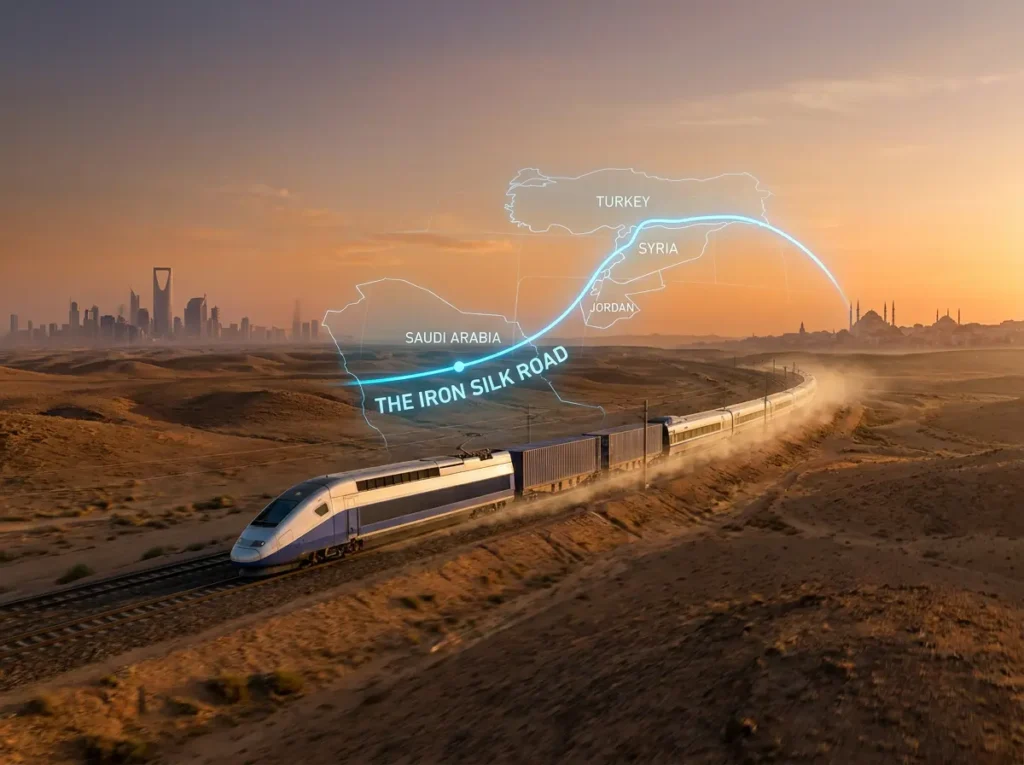
Turkish Transport and Infrastructure Minister Abdulkadir Uraloglu, who travelled to Riyadh personally to sign the agreements, confirmed that the rail link is expected to be completed within three years. In a statement to Al Arabiya, Uraloglu outlined the corridor’s operational route: beginning in Saudi Arabia, traversing Jordan, continuing through Syria, and terminating in Turkey, with the possibility of extension further into Europe. The minister also indicated that Iraq could be integrated into the network at a later stage, broadening the corridor’s economic reach considerably.
The feasibility groundwork has been progressing since at least April 2026, when Saudi Minister of Transport and Logistics Services Saleh Al-Jasser announced that joint studies for the railway were expected to be completed by year-end. “This project will enhance regional integration, support trade, and develop a sustainable land transport system between the countries of the region,” Al-Jasser stated at the time. Earlier that same month, Turkey, Syria, and Jordan signed a trilateral transport memorandum in Amman, committing to advance regional transport integration and modernise the rail links connecting the three countries — the final missing piece in the overland chain.
The Agreements: Scope and Structure
The June 9 signing in Riyadh comprised two distinct instruments, each targeting a different dimension of bilateral cooperation.
The first — a logistics cooperation agreement between the transport ministries — focuses on the development and operation of logistics centres, knowledge exchange between the two countries’ supply chain ecosystems, and the expansion of joint commercial services. The arrangement is designed to give exporters and importers in both Saudi Arabia and Turkey access to multimodal transport options, combining land freight with existing maritime routes to reduce dependency on a single corridor.
The second agreement, signed between Saudi Arabia Railways (SAR) and the Turkish State Railways (TCDD), is a technical and operational memorandum covering railway infrastructure, maintenance and repair cooperation, technology transfer, safety standards, training, and innovation. The agreement builds on earlier institutional contacts between the two operators, formalising a framework for joint execution as physical construction advances.
TCDD Director General and Chairman of the Board Veysi Kurt and SAR Chief Executive Officer Dr. Bashar Al-Malik signed the railway MoU, with both officials subsequently confirming their organisations’ commitment to an implementation timeline aligned with the three-year projection outlined by Turkey’s transport minister.
Strategic Calculus: Why Now
The timing of these agreements is not incidental. Several convergent factors have brought both governments to the negotiating table with new urgency.
Supply chain resilience has moved to the top of the agenda for every major trading nation following successive disruptions — from pandemic-era port congestion to the ongoing tensions in the Red Sea that have elevated the cost and risk profile of maritime routes through the Bab-el-Mandeb Strait. A land corridor through the Levant directly addresses this vulnerability, offering shippers an option that bypasses maritime chokepoints entirely. Senior Saudi trade officials have cited this explicitly, noting that the corridor gives suppliers “multimodal transport options” that reduce exposure to any single route.
Saudi Arabia’s Vision 2030 places logistics infrastructure at the centre of the Kingdom’s economic diversification strategy. The Saudi Landbridge project — a $7 billion rail investment linking the Red Sea port of Jeddah to the Arabian Gulf port of Dammam via Riyadh — is already under development. A northern corridor extending to Turkey would complement this east-west domestic spine with a north-south international artery, positioning Saudi Arabia as a pivot of regional freight, not merely a terminal destination.
Turkey’s geopolitical and commercial positioning is equally deliberate. Ankara has invested heavily in the concept of land-based trade corridors as a counterweight to its dependence on maritime access. The Middle Corridor — running through the Caspian and Central Asia — is one axis of this strategy; the Hejaz revival offers a southern axis connecting Turkey more directly to Gulf markets, which represent some of Turkey’s most significant bilateral trade relationships.
Post-conflict regional normalisation has opened corridors that were previously impassable. Turkey’s engagement with Syria, which has accelerated dramatically following the fall of Bashar al-Assad’s government in late 2024, has made physical rail reconnection through Syrian territory a practical possibility for the first time in over a decade. Turkey has already committed to rebuilding 30 kilometres of destroyed track to reconnect its network to the Syrian border.
The Route: Infrastructure Realities
The physical challenge of realising this corridor is substantial but not insurmountable. Saudi Arabia has already extended its rail infrastructure to the Jordanian border — the Al-Haditha crossing has been identified as the key entry point. Turkey has expanded its railway system as far as the Syrian border. The critical missing link lies in the Syrian territory between the two — a stretch that Turkey has committed to restoring and that Syria, under its new government, has signalled willingness to facilitate.
Jordan’s role in the project is both geographic and institutional. As the land bridge between Saudi Arabia and Syria, Jordan’s cooperation is non-negotiable. The April 2026 trilateral memorandum in Amman confirmed that Amman is a committed partner, and Jordan’s own economic interest in becoming a transit hub for Gulf-European trade provides strong domestic incentive to move the project forward.
When completed, the corridor is projected to carry 4.5 million passengers and 10 million tonnes of cargo annually, with average train speeds of 250–300 km/h on the high-speed segments. The economic implications extend well beyond bilateral trade: the route could potentially shorten freight transit times from the Gulf to Europe by several days compared to sea routes, with transformative consequences for the cost structures of manufacturers and retailers across the region.
Broader Regional Implications
The emergence of this corridor sits within a wider pattern of infrastructure-led diplomacy in the post-pandemic, post-conflict Middle East. Saudi Arabia’s new international rail logistics corridors — aimed at linking the Kingdom’s eastern ports with the Al-Haditha crossing — have drawn the interest of the United States, which has identified Jordan as a centrepiece of an emerging regional connectivity framework. Washington’s backing of Jordan’s role in such corridors underscores that the rail project is not purely a bilateral Saudi-Turkish undertaking, but a multi-stakeholder infrastructure play with geopolitical dimensions that extend into the ambitions of major powers.
For Iraq, potential inclusion in the network at a later stage would mark a significant step in its own post-conflict economic reconstruction, opening an additional trade route to both the Gulf and Europe without dependence on Iranian territory — a factor of considerable strategic importance given the ongoing volatility of the Iran-Iraq-Syria corridor.
What Comes Next
The signing of MoUs marks a beginning, not an endpoint. The joint studies initiated between Saudi Arabia and Turkey are due for completion by the end of 2026, and those findings will determine the precise routing, phasing, investment structure, and financing mechanisms for the project. Turkey’s minister indicated that cost details for the full Riyadh-Ankara link will become clear once those studies conclude.
Execution will require sustained political will across multiple sovereign jurisdictions — Saudi Arabia, Jordan, Syria, and Turkey at minimum — and significant capital mobilisation. Yet the institutional groundwork now in place, combined with the strategic alignment of incentives for all parties involved, suggests that this project is on a materially different trajectory than previous attempts to revive the Hejaz corridor.
For the business communities of the Gulf, the Levant, and Anatolia, the implications are profound. A functioning overland rail corridor connecting Riyadh to Istanbul would represent the most significant reconfiguration of Middle Eastern trade infrastructure in a generation — one that could, over time, reshape sourcing strategies, warehousing locations, and competitive dynamics across the sectors that define the region’s commercial landscape.
The Saudi Ministry of Transport and Logistics Services is the Kingdom’s central government authority responsible for planning, developing, and regulating all transport sectors — including road, rail, aviation, maritime, and logistics. Under the framework of Vision 2030, the ministry has assumed a strategic role in transforming Saudi Arabia into a global logistics hub, with a mandate to diversify the Kingdom’s economic base through world-class infrastructure investment. Its current priorities include the Saudi Landbridge rail project, port expansion at Jeddah and Dammam, and the development of international connectivity corridors linking the Kingdom to neighbouring markets.
Saudi Arabia Railways (SAR) is the national railway company of the Kingdom of Saudi Arabia, responsible for the planning, construction, operation, and maintenance of the country’s rail network. SAR operates the North-South Railway — one of the longest in the world at over 2,750 kilometres — as well as the Haramain High Speed Railway connecting Mecca and Medina. The company is a key instrument of Saudi Arabia’s Vision 2030 infrastructure strategy and is currently engaged in multiple international cooperation frameworks aimed at positioning the Kingdom as a regional rail hub. SAR is led by Chief Executive Officer Dr. Bashar Al-Malik.
Turkey’s Ministry of Transport and Infrastructure is the primary government body overseeing national and international transport policy, infrastructure investment, and connectivity strategy for Türkiye. The ministry has championed a series of ambitious rail and multimodal corridor projects as part of Turkey’s broader ambition to serve as a land bridge between Asia and Europe. Under Minister Abdulkadir Uraloglu, the ministry has been at the forefront of diplomatic efforts to revive and extend the Hejaz Railway corridor, engaging simultaneously with Saudi Arabia, Jordan, Syria, and Iraq in pursuit of a cohesive regional rail network.
TCDD is the state-owned railway operator of the Republic of Turkey, operating an extensive national network that connects major urban centres and industrial hubs across Anatolia. TCDD has been central to Turkey’s infrastructure ambitions, particularly in the development of high-speed rail links and the expansion of its network toward Turkey’s eastern and southern borders. The organisation is led by Director General and Board Chairman Veysi Kurt, who signed the June 2026 MoU with SAR as part of the broader bilateral framework.
Originally constructed between 1900 and 1908 under Ottoman authority, the Hejaz Railway connected Damascus to Medina across 1,300 kilometres, serving primarily as a pilgrimage route for Muslims travelling to the holy cities. The line was severely damaged during the Arab Revolt and the First World War and was never fully restored. Its revival — now being pursued as a modern freight and passenger corridor — carries both economic and symbolic significance as a reconnection of communities and economies long separated by conflict and political fragmentation.
Cosmopolitan The Daily is a global business publication delivering comprehensive coverage of Finance, Technology, Energy, Real Estate, and other key sectors across international markets. With offices in New York, London, Dubai, Bangalore, Toronto, Kuala Lumpur, and Sydney, we provide breaking news and in-depth market insights to directors and executives of leading companies worldwide. Our publication combines authoritative business journalism with our annual Business Excellence Awards programme, recognising innovation and excellence across industries and geographies.