Kazakhstan’s national railway operator is accelerating an ambitious expansion of its rail infrastructure, port facilities, and cargo capacity as mounting instability across the Middle East compels shippers to seek more dependable overland corridors between China and Europe. The development underscores a structural realignment in global supply chains with far-reaching implications for trade, investment, and geopolitical leverage across the Eurasian continent.
Kazakhstan Temir Zholy (KTZ), the state-owned rail operator, confirmed that tensions surrounding the Strait of Hormuz and the ongoing Iran conflict are driving a sustained surge in demand for land-based freight alternatives to traditional sea routes. The operator is responding with a multi-billion-dollar programme to build out the infrastructure backbone required to handle rising cargo volumes.
“Chinese clients have become more interested in shipping by land rather than by sea because of reliability and predictable delivery times,” KTZ Chief Executive Officer Talgat Aldybergenov
The Middle Corridor: A Route Whose Moment Has Arrived
At the heart of this transformation is the Trans-Caspian International Transport Route (TITR) — commonly referred to as the Middle Corridor — a multimodal freight artery linking China and Europe through Kazakhstan, Azerbaijan, Georgia, and Turkiye. The route bypasses both the congested Suez Canal and the sanctions-shadowed Russian rail network, positioning it as the geopolitically neutral path of choice for international shippers.
The corridor’s strategic importance has been building steadily since February 2022, when Russia’s military intervention in Ukraine prompted major logistics providers and their clients to reroute shipments away from Russian territory. The shift has proven durable. According to estimates from UK-based Abrdn Investments Ltd, cargo volumes along the Middle Corridor have increased approximately tenfold since 2022 — a staggering acceleration that reflects both the scale of global disruption and Kazakhstan’s growing ability to absorb redirected trade flows.
The current spike in Middle East tensions has added further momentum to that trend. With maritime routes through the Persian Gulf facing renewed uncertainty, the appeal of an overland alternative offering consistent transit times and reduced exposure to conflict zones has strengthened considerably among Chinese exporters and European importers alike.
Kazakhstan’s Strategic Infrastructure Build-Out
KTZ’s expansion programme encompasses upgrades to rail capacity across key transit corridors, the development of Caspian Sea port infrastructure — particularly at the port of Aktau — and investments in intermodal logistics hubs designed to streamline the handover of cargo between rail, road, and sea transport. The combined investment is part of Kazakhstan’s broader ambition to position itself as the pre-eminent transit economy connecting East Asia with Europe.
The scale of the undertaking reflects the commercial opportunity that Kazakhstan’s government and state enterprises are now openly pursuing. As a landlocked nation with some of the world’s largest hydrocarbon reserves and a geographic footprint that places it at the intersection of multiple major trade flows, Kazakhstan has long recognised that infrastructure is its most durable competitive asset in the global logistics market.
The current environment — defined by persistent Russian sanctions, an unpredictable Middle East, and a China that is actively diversifying its export pathways — has compressed timelines and elevated the urgency of that build-out considerably.
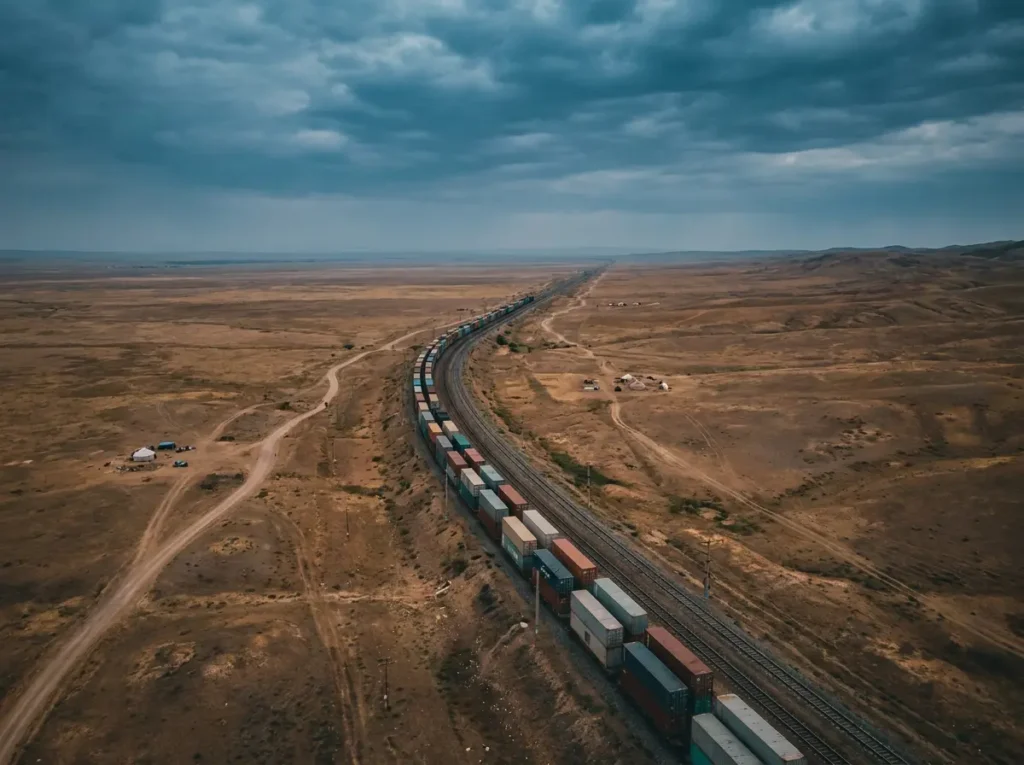
A Tenfold Volume Surge and What It Signals
The figures cited by Abrdn Investments Ltd are remarkable by any measure. A tenfold increase in cargo volumes since 2022 signals not merely a temporary detour but a genuine rerouting of supply chain architecture. Logistics operators, freight forwarders, and major manufacturers are revising long-term routing strategies to account for what now appears to be structural, rather than cyclical, disruption across both the Russian and Middle Eastern corridors.
For Kazakhstan, the implications are equally significant. Transit revenues contribute to the national economy, but the more enduring benefit lies in the development of logistics expertise, ancillary services, and the attraction of foreign direct investment into warehousing, free trade zones, and value-added manufacturing along the corridor.
The Middle Corridor now commands attention not only from national governments but from the institutional investment community. Abrdn’s tracking of corridor volumes reflects a broader interest among global asset managers in Central Asian infrastructure as an emerging asset class — one whose risk-adjusted returns are increasingly difficult to overlook given the structural tailwinds now in play.
Broader Implications for Global Trade Architecture
The consolidation of the Middle Corridor as a primary China-Europe trade route represents one of the most consequential shifts in global logistics geography in decades. It is a development shaped not by market efficiency alone, but by the collision of geopolitical forces — the Russia-Ukraine conflict, Middle Eastern instability, and China’s strategic imperative to reduce dependence on maritime chokepoints it does not control.
For European businesses, this means a more diverse and resilient set of supply chain options for sourcing goods from Asia. For Chinese exporters, it offers a meaningful hedge against maritime disruption. And for Kazakhstan and its corridor partners — Azerbaijan, Georgia, and Turkiye — it presents a generational opportunity to embed themselves as indispensable nodes in the architecture of Eurasian commerce.
Whether that opportunity is fully realised will depend on the pace and quality of infrastructure investment, the regulatory harmonisation among corridor countries, and the ability of KTZ and its partners to scale operations without sacrificing the reliability that has become their primary commercial proposition.
For now, the direction of travel is clear: the world’s freight is moving overland, and it is moving through Kazakhstan.
Kazakhstan Temir Zholy (KTZ) is the Republic of Kazakhstan’s state-owned national railway operator and one of the largest rail networks in the world by total route length. Headquartered in Astana, KTZ manages approximately 16,000 kilometres of rail infrastructure and operates freight, passenger, and logistics services across Kazakhstan and international transit corridors. As the operator of the country’s primary rail arteries, KTZ plays a central role in the Trans-Caspian International Transport Route (Middle Corridor) and is a cornerstone of Kazakhstan’s strategy to develop its position as a major Eurasian transit hub. The company is owned by the state holding company Samruk-Kazyna and is a key driver of infrastructure investment in the region.
Abrdn plc (formerly Standard Life Aberdeen) is a global investment company headquartered in Edinburgh, Scotland. With assets under management exceeding £500 billion at its peak, Abrdn serves institutional investors, pension funds, and wealth management clients across the globe. The firm provides active investment management across equities, fixed income, real assets, and multi-asset strategies. Abrdn has a particular focus on emerging and frontier markets, including Central Asia, where it tracks infrastructure development and trade corridor growth as part of its global macroeconomic and thematic research. The company is listed on the London Stock Exchange and is a constituent of the FTSE 100 Index.
Cosmopolitan The Daily is a global business publication delivering comprehensive coverage of Finance, Technology, Energy, and Real Estate across international markets. With editorial offices in New York, London, Dubai, Toronto, Bangalore, Kuala Lumpur, and Sydney, the publication provides breaking news and in-depth market intelligence to directors and executives at leading companies worldwide. Beyond its daily editorial output, Cosmopolitan The Daily operates an annual Business Excellence Awards programme, formally recognising innovation and outstanding performance across industries and geographies. Our readership comprises senior decision-makers who demand authoritative, fact-driven journalism with a truly international perspective.