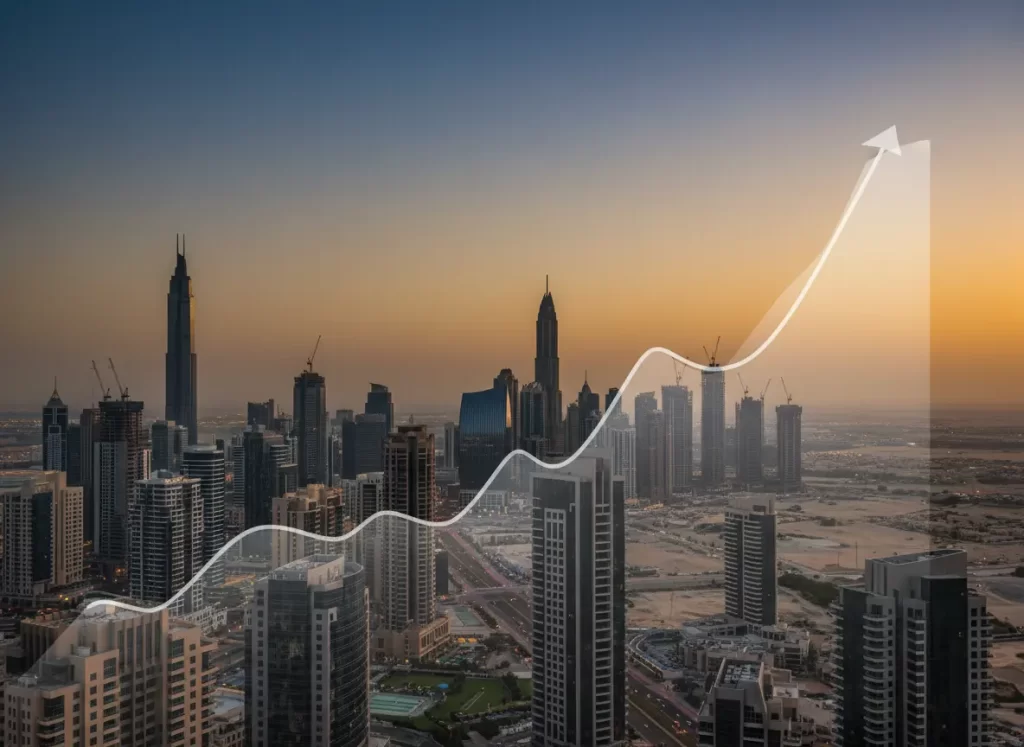
Dubai’s real estate market is showing a familiar trait in periods of geopolitical noise: resilience.
While Middle East tensions can trigger short-term caution in global capital flows, Dubai’s property ecosystem has matured into a more diversified, institutionally supported market than in previous cycles. Transaction activity may soften at the margins during periods of heightened uncertainty, but the underlying fundamentals—population growth, long-term residency reforms, deep international investor participation, and continued infrastructure delivery—continue to support stability across key segments.
Why Dubai real estate is staying stable
Several structural factors are helping Dubai avoid the abrupt stop-start patterns that often follow regional shocks:
- A broad investor base: Demand is not reliant on a single geography. Buyers span GCC, South Asia, Europe, CIS markets, and an expanding pool of global HNW investors.
- A diversified economy: Dubai’s growth is increasingly linked to services, trade, tourism, technology, and finance—not only regional commodity cycles.
- A mature regulatory environment: Escrow requirements and tighter project oversight have strengthened buyer confidence, particularly in off-plan.
- Rental-market support: Strong occupancy and yields in many communities help underpin pricing, even when sentiment turns cautious.
Key companies shaping Dubai’s market right now
Dubai’s stability is also a function of execution—major developers continue to deliver master-planned communities, waterfront destinations, and mixed-use districts that keep end-user and investor demand engaged.
Based on current market visibility and developer activity, key names to watch include:
- Emaar Properties – Flagship developer behind Downtown Dubai and other large-scale communities.
- Dubai Holding (Nakheel & Meraas) – Master developers associated with landmark waterfront and lifestyle destinations.
- DAMAC Properties – A major player in luxury-led communities and branded residential concepts.
- Sobha Realty – Known for quality-led developments and vertically integrated delivery.
- Binghatti – A fast-scaling developer recognised for bold architecture and branded towers.
- Azizi Developments – Active across multiple mid-market and investment-focused projects.
- Select Group – A prominent name in premium residential and mixed-use developments.
- Danube Properties – A leading “affordable luxury” developer with payment-plan driven demand.
What to watch in the coming months
For executives, investors, and corporate decision-makers tracking Dubai real estate as a barometer of regional confidence, the next phase will likely be defined by three practical indicators:
- Off-plan absorption vs. new supply – Launch volumes remain high; the key question is how quickly inventory clears.
- Mortgage and liquidity conditions – Financing appetite and bank risk posture will influence mid-market momentum.
- Buyer composition – A continued tilt toward end-users and long-term residents typically signals durability.
Bottom line
Regional tensions can influence sentiment, but Dubai’s real estate market is increasingly supported by fundamentals that extend beyond headlines. The city’s ability to attract global talent, capital, and long-term residents—combined with consistent delivery by major developers—continues to position Dubai as a market that absorbs volatility rather than amplifies it.
Cosmopolitan The Daily is a global business publication covering Finance, Technology, Energy, Real Estate, and other sectors. We deliver breaking news and in-depth insights for directors, executives, and decision-makers worldwide, alongside our annual Business Excellence Awards program.